Consultants’ Comments
- “After five years of use, RelyX Unicem continues to be the most widely used cement in our office. ”
- “Simple cement for fiber posts.”
- “Very few debonds.”
- “Very mild cement with little sensitivity at cementation.”
- “Remove excess cement before it is fully set.”
- “Quick, easy to use, easy to clean, and very reliable outcome.”
Description
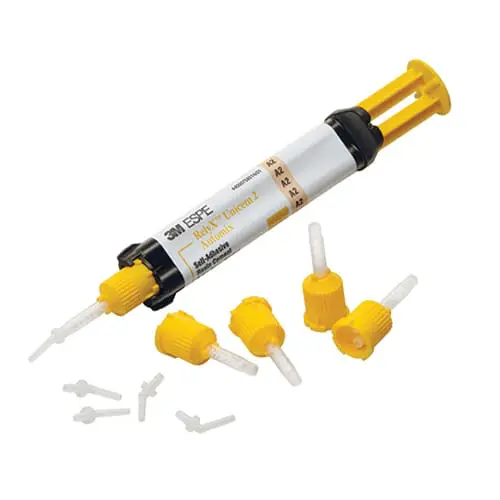
3M ESPE RelyX Unicem Self-Adhesive Universal Resin Cement is a dual-cured resin cement. It is self-adhesive, requiring no tooth surface preparation such as etching or priming. The cement is filled 72% by weight and contains fluoride. RelyX Unicem is available in two capsule sizes (Aplicap and Maxicap) in shades A1, A2, A3-opaque, white opaque, and translucent. It is indicated for the cementation of metal, PFM, ceramic and laboratory composite crowns, bridges, inlays, onlays, and metal or fiber posts. It is not recommended for the cementation of veneers. Working time is 2 minutes for the Aplicaps and 2.5 minutes for the larger Maxicaps. The Aplicaps have enough material to cement one to two restorations, whereas the Maxicaps have enough material for three to five restorations. RelyX Unicem is also available in a paste/paste formulation delivered by the recently released Clicker Dispenser. This product received a 99% clinical rating.
Clinical Evaluation Protocol
More than 5,000 restorations have been cemented with RelyX Unicem over the past 5.5 years. These restorations include all-ceramic inlays, onlays, crowns, bridges; PFM crowns and bridges; and posts (Figure 1).
1,820 restorations were available for recall.
380 of the recalled restorations were cemented for five years or longer.
Characteristics evaluated at recall include:
- Postoperative sensitivity
- Resistance to marginal discoloration
- Debonding

Figure 1
Clinical Observations
Postoperative Sensitivity
Since its introduction and subsequent monitoring over a five-year period, RelyX Unicem has had few reports of postoperative sensitivity. At five-year recall, 1.8% of patients reported occasional temperature sensitivity (Figure 2). Factors such as less manipulation of the prepared tooth and fewer steps for cementation may contribute to the low incidence of postoperative sensitivity.
Resistance to Marginal Discoloration
Of the 380 recalled restorations cemented for five years, 5.1% had evidence of microleakage (Figure 2). Two percent of the recalled restorations required replacement for this reason. Microleakage is exhibited by graying margins of all-ceramic restorations, which may result from improper isolation or improper pretreatment of the restoration. Microleakage can also result from excessive bruxism, causing a compromise of the bond at the cervical margin and allowing the ingress of fluid and bacteria. The rate of microleakage of restorations cemented with RelyX Unicem is comparable to restorations cemented with 5th– and 6th-generation bonding agents and corresponding light- or dual-cured resin cements.
Debonding
A low debonding rate was documented over the five-year evaluation period. In 1,820 recalled restorations cemented with RelyX Unicem, 39 (0.8%) required re-cementation (Figure 2). These included 22 ceramic onlays, 10 ceramic crowns, and 7 PFM crowns. Of the 22 ceramic onlays that debonded, 11 had little direct retention, In four of these debonding cases, a portion of the tooth fractured.

Figure 2
Summary
RelyX Unicem has proven to be an excellent and reliable self-adhesive resin cement in the five years since its introduction.