
Consultants’ Comments
- “Very easy to use and place.”
- “Nice single-dose dispensing.”
- “Foil package maintains moisture keeping the material hydrated.”
- “Material remains soft in the canal.”
- “Make the syringe tip diameter smaller.”
Description
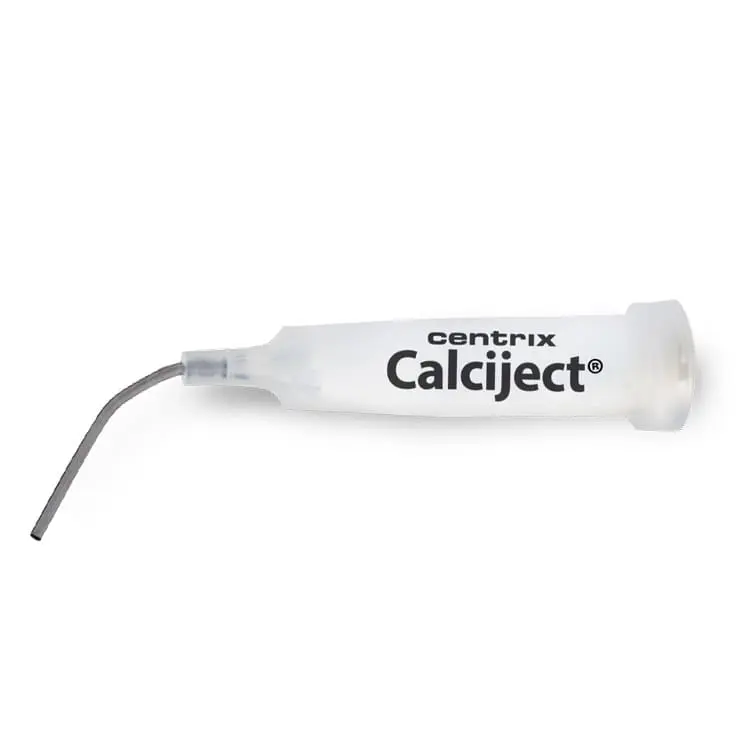
Calciject is a fine-grain pure calcium hydroxide paste for use in temporary and intermediate root canal therapy. The paste has a high pH and is bacteriostatic. It is designed to aid in dentin bridge formation, periapical healing and for apexification. Calciject is opaque white in color, radiopaque and comes packaged in singledose, needle-tube syringe tips. Individual syringe tips are sealed in foil packages. The material does not require any mixing and can be injected directly into the tooth using a Centrix C-R® syringe or a standard composite syringe. Twenty-seven consultants evaluated Calciject in over 180 cases.
Product Features
The packaging of the material was highly rated and the pre-loaded tips were easy to place into a Centrix syringe. Many consultants reported that dispensing the material was convenient because of the long metal, bendable tips. The most-liked features of Calciject were the ease of use and placement, as well as the flow of the material. Complete coating of root canals is aided by the low viscosity, but still requires files or paper points to assist in material dispersal. Although the material flowed well, many consultants felt that an increased viscosity would have helped to control placement. Working time is very good, and the amount of material is sufficient for multi-rooted teeth. Though the biological effects of the material were not evaluated, no problems or unfavorable results were reported. Two out of three evaluators judged Calciject to be equivalent to or better than the current product they use for endodontic canal treatment. Thirty-three percent of consultants indicated that they would switch to Calciject and 63% would recommend it to a colleague.
Clinical Tips
- A file, lentulo or paper point can also be used to distribute material in canal.
- To avoid expressing material into the periapical space, don’t force the needle into the canal.