

Consultants’ Comments
- “Nice radiopacity of posterior shades.”
- “Restorations are undetectable.”
- “This has become my favorite composite.”
- “Some shades are too translucent when used alone.”
Description
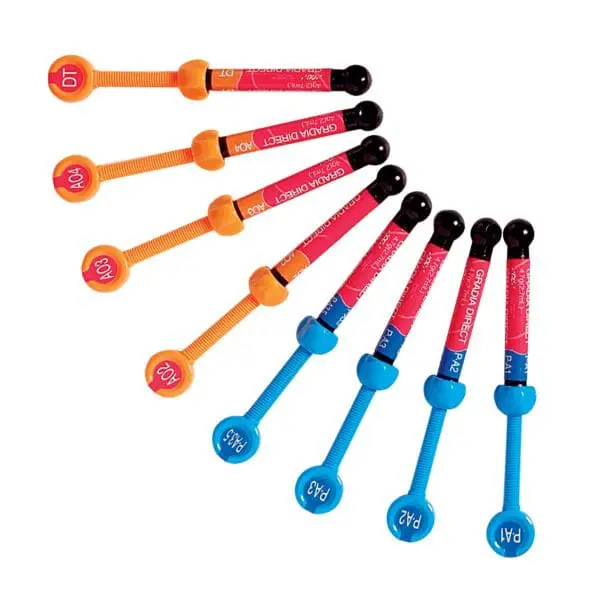
GRADIA DIRECT is a microhybrid resin composite system for anterior and posterior use. The system features 26 shades in both unitip capsules and syringes. Different formulations exist for anterior and posterior use. Anterior shades are radiolucent, have a creamy consistency, and emphasize esthetics and gloss. Posterior shades are radiopaque and have a heavier body for packing in interproximal areas. Standard shades alone are adequate for use in the majority of restorations. In cases of complex esthetic restorations, special “Inside” (opaque) and “Outside” (translucent) shades are provided. Shades available include: standard Vita shades, 11 anterior and four posterior; outside shades, six anterior and two posterior; inside shades, three anterior. The complete kit includes 26, 2.7-g syringes or 106, 0.16-ml unitips of composite with a shade guide. This product received a 96% clinical rating.
Clinical Evaluation Protocol
325 restorations in 181 patients were evaluated at two years.
Restorations evaluated included 283 posterior and 42 anterior restorations (Figure 1).
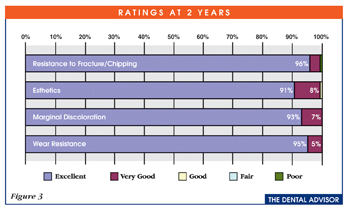
Categories were rated on a 1-5 scale:
1 = poor, 2 = fair, 3 = good, 4 = very good, 5 = excellent. (See Figures 2 and 3).
Figure 1
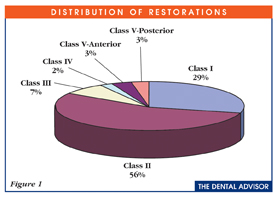
Figure 2
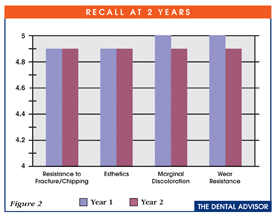
Figure 3
Clinical Observations
Resistance to Fracture/Chipping
Ninety-six percent of GRADIA DIRECT restorations were free of chips or fractures at two years. Of the 325 restorations recalled, two required replacement for fracture of the restoration. One restoration required repair, and 10 others exhibited very small chips that required refinishing.
Esthetics
The esthetics of GRADIA DIRECT rated very good to excellent. Shades remained accurate and restorations blended very well with the teeth. The variety of available shades contributed to excellent esthetics in anterior restorations. While well over 90% of the posterior restorations were completed with a single shade, most anterior Class IV restorations utilized two to three shades. Similar restorations utilizing only the standard shade were rated too translucent. Consultants noted that the surface texture of the composite remained smooth with finishes ranging from glossy to matte. Two percent of restorations showed discoloration or staining.
Marginal Discoloration
Marginal discoloration, or microleakage, can be influenced by factors such as the restorative material, finishing procedures, bonding agent, and bonding technique. A variety of bonding agents were used during placement of GRADIA DIRECT restorations. At two-years, 93% of the restorations were free of marginal discoloration, compared to 99% at one year. Those restorations exhibited mild staining and only one anterior restoration required refinishing of the margins.
Wear Resistance
Ninety-five percent of restorations were rated excellent for wear resistance. The remaining 5% rated very good, showing mild wear. In some of those cases consultants noted wear on functional cusps or evidence of bruxism.


