


Consultants’ Comments
- “Beautiful shade match.”
- “Very nice fit – margins were undetectable.”
Description
IPS e.max Press (Ivoclar Vivadent) is a high-strength, lithium disilicate ceramic used for anterior and posterior restorations as well as three-unit bridges. IPS e.max can be overlaid with IPS e.max Ceram to optimize esthetics. This product received a 96% clinical rating.
Clinical Evaluation Protocol
Four dentists placed 440 IPS e.max restorations in 260 patients over a four-year period.
Two hundred thirty-six restorations were recalled over a six-month period (Figure 1).
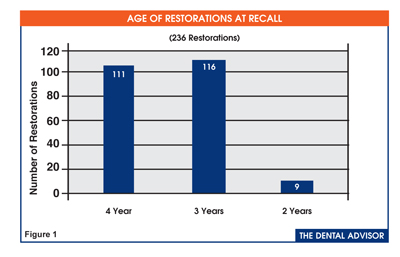
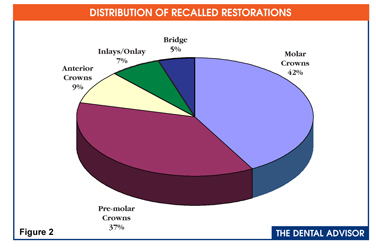
Approximately half of these were in function for four years while the other half were in function for three years. The restorations were crafted by Nellmar Laboratory for posterior and anterior teeth, with a variety of crowns, inlays/onlays and bridges (Figure 2).
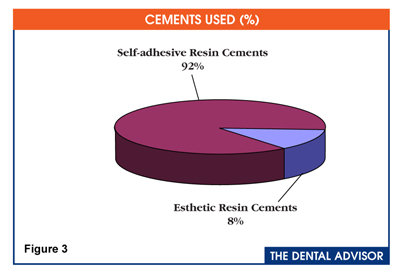
Before cementation the internal surfaces of all restorations were etched with 5% hydrofluoric acid gel for 20 seconds, then rinsed and coated with a silane such as Monobond Plus. All restorations were cemented with either self-adhesive resin or esthetic resin cements (Figure 3). The restorations were recalled at approximately six-month intervals. During the recall five areas (esthetics, resistance to fracture or chipping, resistance to marginal discoloration, sensitivity, debonding) were evaluated and rated on a 1 to 5 scale (1=poor, 2=fair, 3=good, 4= very good, 5= excellent).
Results at Four Years
Esthetics
Ninety-four percent of the IPS e.max restorations received a five or an excellent rating (Figure 4). The restorations were not only clinically acceptable but also of superior esthetic quality. Many patients remarked positively on the esthetics of the restorations. Figure 5 shows an IPS e.max onlay at four years. Only 6% of the restorations were slightly opaque and lacked sufficient translucency which could be a function of ingot selection. IPS e.max is available in four translucencies (LT, HT, MO, HO).
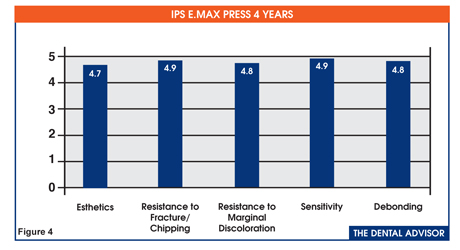
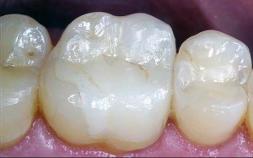
Figure 5. IPS e.max #3 onlay at 4 years.
Resistance to Fracture/Chipping
Of the 236 restorations recalled, one fractured and needed replacement (Figure 4). This was a second molar crown. Only six restorations, two onlays and four crowns, exhibited minor chipping that was smoothed and polished, and none needed to be replaced. Of the chipped crowns, two were second molars and two were first molars. Only 2.5% of the restorations exhibited some chipping at four years and only 0.5% had fractured and needed replacement. This rate is lower than other ceramics documented by THE DENTAL ADVISOR over the past 26 years.
Resistance to Marginal Discoloration
The lack of marginal discoloration of the restorations was excellent in 95% of the cases (Figure 4). Leakage at the margins is not just related to the fit but more to the bonding and the resin cement. In 3% of the recalled cases, some graying at the margins was noted but none necessitated their replacement.
Sensitivity
Only four cases (2%) of postoperative sensitivity were reported by patients (Figure 4). These were mild in nature and subsided over time.
Debonding
Nine restorations (4%) debonded and needed to be recemented (Figure 4). This debonding rate is similar to debonding rates of other all-ceramic restorations monitored over 26 years by THE DENTAL ADVISOR and is related to the preparation and the cement rather than the ceramic.
Summary
IPS e.max Press has proven to be a very esthetic, high-strength, durable material with excellent clinical performance over the four-year recall period. Its performance has exceeded that of traditional PFM restorations as well as many all-ceramic restorations. IPS e.max Press is highly recommended by THE DENTAL ADVISOR.


