

Consultants’ Comments
- “I liked the easy, convenient packaging and that it is a single patient use disposable item.”
- “The cup and point shapes worked best on the occlusal surfaces of posterior restorations.”
- “Fit to handpiece was awesome; great durability; shapes are useful.”
- “Final finish was acceptable for posterior restorations; however, I would like a better surface finish and gloss in esthetic areas.”
Description
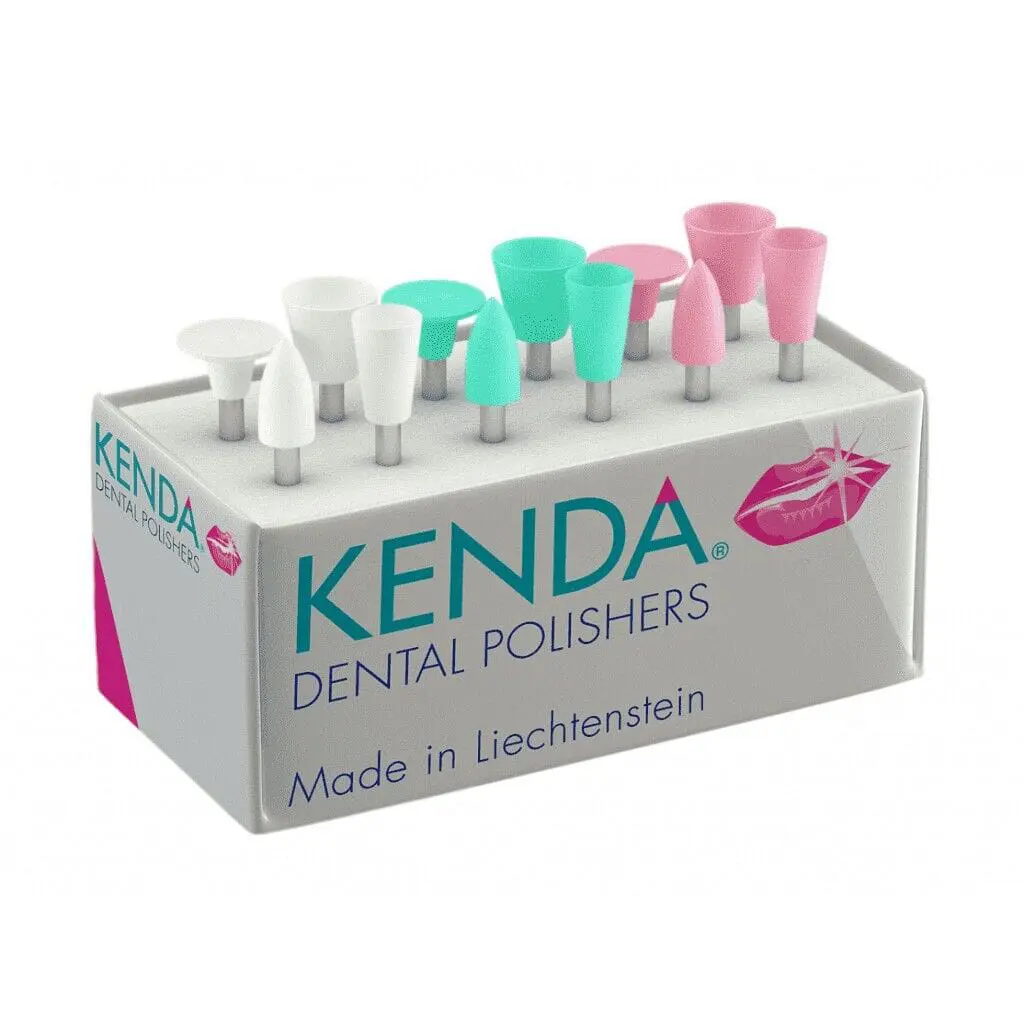
KENDA BIG JOB is a one-step composite polishing system for single patient use. It is designed for fine surface polishing of single and multiple composite restorations. KENDA BIG JOB consists of silicone rubber and aluminum oxide with shanks made of medical plastic. They are for use in a RA latch handpiece at 5,000 rpm with a water spray. The polishers are provided in kits including four of each of the three shapes (disk, cup and point) as well as packages of 6, 12, 25 and 100, in each shape. KENDA BIG JOB was used 411 times by 20 consultants. It received a 91% clinical rating.
Product Features
Consultants liked the variety of shapes of KENDA BIG JOB, and noted that the polishers maintained their shapes well during the procedure from start to finish and adapted well to the tooth. For a disposable polisher KENDA BIG JOB is very durable. The single-step polisher did a good job of smoothing composite surfaces. The quality of the final polish was smooth but not extremely glossy, yet was perceived as smooth to patients. Care must be taken to avoid abrading the soft tissue with the polisher. Twenty-five percent of consultants reported that KENDA BIG JOB was better than their current polishing system; 40% reported this product was equivalent to their current polishing system. Thirty-five percent would switch and 60% would recommend this product.
Clinical Tips
Start with more pressure from high to low – use with water.
KENDA BIG JOB can be autoclaved if contaminated.

