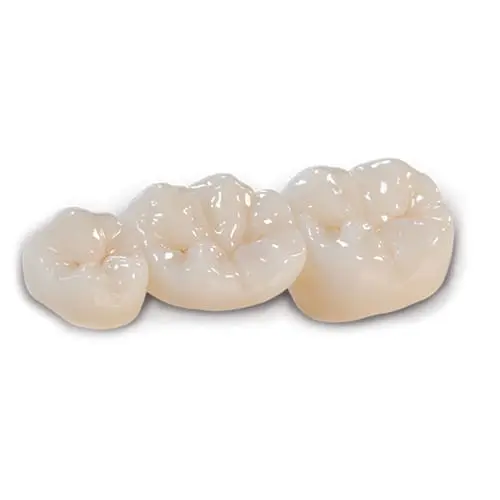
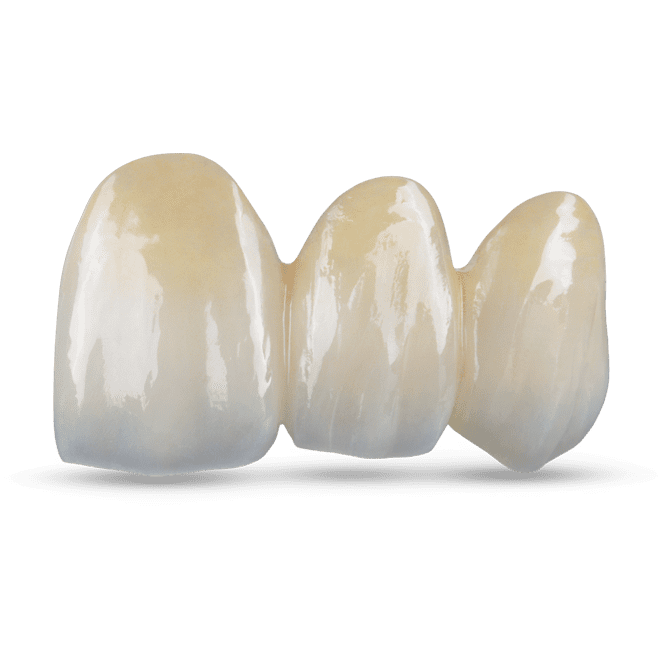
Purpose:
Obsidian is a lithium silicate glass ceramic that exhibits excellent translucency, resulting in superior esthetics. It is indicated for crowns, inlays, onlays, and veneers; possesses above average flexural strength and is recommended mainly for anterior and premolar crowns.
Clinical Evaluation Protocol:
A total of 226 Obsidian restorations were placed over a 12-month period. By year three, 206 had been recalled. The Obsidian restorations included 64 anterior crowns, 140 premolar crowns and 2 molar crowns (Figure 1). Both upper and lower teeth were restored. Tooth preparation guidelines provided by Glidewell Dental Laboratories were followed. All restorations were fabricated and the internal surface pre-etched by Glidewell Dental Laboratories. Forty restorations were cemented with self-adhesive resin cements and 186 were cemented with adhesive resin cements (Figure 2).


Results at Three-year Recall:
Two hundred and six restorations (88% of the total number of restoration placed) had been recalled by year 3 and were evaluated in the following areas: esthetics, resistance to fracture/chipping, resistance to marginal discoloration, wear resistance, and retention. Of the recalled restorations, 114 had been in function for approximately 2 years and up to 3 years (55% of all recalled restorations) (Figure 3). Restorations were evaluated on a 1-5 rating scale: 1 = poor, 2 = fair, 3 = good, 4 = very good, 5 = excellent.

Esthetics
There were 198 Obsidian crowns that received an excellent rating of five for esthetics (Figure 4). Eight crowns recieved a rating of 4. Patients, doctors and staff continued to report how natural and beautiful the crowns looked.
Resistance to Marginal Discoloration
To date, only two of the recalled Obsidian restorations have exhibited slight microleakage in the vicinity of the cervical margin and neither needed any intervention (Figure 4). This is unchanged from the 30-month clinical performance report.
Resistance to Fracture and Chipping
For recalled restorations, 197 of 206 Obsidian restorations (96%) exhibited excellent resistance to fracture/chipping (Figure 4). Of the remaining 9 crowns, 4 were premolar crowns that fractured, including one when the patient hit his head in a work-related injury. Two additional premolar crowns were replaced due to hairline cracks, and an anterior crown fractured in a patient who was a heavy bruxer and not wearing a bit splint.
Wear Resistance
The wear resistance of the recalled Obsidian crowns was superb, with 205 of 206 crowns receiving an excellent rating. The remaining crown received a rating of very good (Figure 4).
Retention
Other than the one crown that fractured, four recalled Obsidian crowns had debonded at 3 years (Figure 4). For one of these crowns, the core also debonded and a new core and crown was provided. The other three crowns were cleaned, etched and recemented using adhesive resin cement.
Summary
Over a three-year period, the clinical performance of recalled Obsidian crowns was exceptional. Esthetics, resistance to marginal discoloration and wear resistance were excellent. The restorations will continue to be monitored over time. At three years, Obsidian receieved a clinical performance rating of 98%.