

Consultants’ Comments
- “Very little marginal discoloration was exhibited during the two years, indicating a strong bond strength”
- “Applying the ceramic primer during placement was easy and it appears to have enhanced the bond of the cement to the restoration.”
- “In most cases, debonds resulted in all residual cement on the internal surface of the crown.”
Description
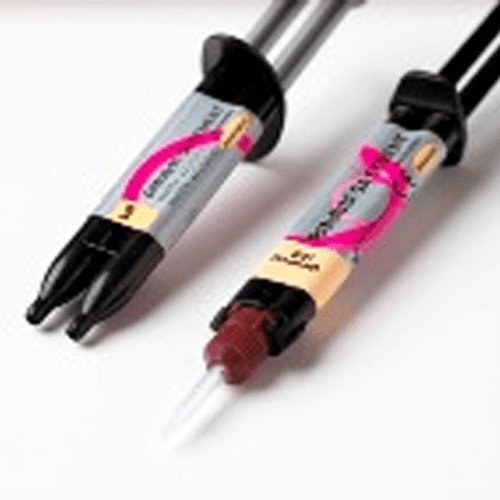
PANAVIA SA CEMENT is a self-adhesive, dual-cured resin cement with fluoride release. It is based on the PANAVIA and CLEARFIL SE BOND adhesive technology and has a reported film thickness of approximately 20 microns. It is indicated for cementation of crowns and bridges made of metal or ceramic, inlays/onlays, and metal and fi ber posts. It is packaged in handmix and automix syringes in Universal (A2) and White shades.
CLEARFIL CERAMIC PRIMER is a single-bottle, silane/acidic adhesive monomer (MDP)-based coupling agent for use with indirect porcelain, ceramic, and composite restorations. It may also be used for intraoral porcelain or composite repairs. CLEARFIL CERAMIC PRIMER bonds to feldspathic porcelain, zirconia, alumina, lithium disilicate, and leucite-reinforced ceramics. No hydrofluoric acid etching is necessary for ceramics before using this product. Instructions recommend a single coat followed by air-drying. This product combination received a 98% clinical rating.
Clinical Evaluation Protocol
A total of 274 restorations were cemented with PANAVIA SA CEMENT. Restorations included: 145 zirconia-based restorations, 121 lithium disilicate restorations, six leucite-reinforced restorations, and two ceramic-metal restorations. Restorations were placed on 236 posterior and 38 anterior teeth.
– CLEARFIL CERAMIC PRIMER was applied to the internal surface
of the lithium disilicate and leucite-reinforced restorations.
– Zirconia restorations were not primed.
| Results at Placement | ||||
| Handling of cement and ease of clean up of excess | Fit of restoration | Shade match/esthetics | Marginal integrity | Initial sensitivity |
| PANAVIA SA CEMENT received an excellent rating for ease of removal of excess after placement. | All restorations cemented with PANAVIA SA CEMENT had excellent marginal fit. The contacts and occlusion were ideal before cementation. | The optimal esthetics of the restorations was maintained after cementing the restorations with PANAVIA SA CEMENT. | The viscosity of the cement allowed passive cementation of the restorations resulting in preservation of the ideal marginal fit of the restorations. | The majority of the teeth exhibited no sensitivity after cementation of the restorations. |
• A total of 257 restorations, cemented with PANAVIA SA CEMENT, were available for evaluation of clinical performance up to two years after placement. Restorations included: 133 zirconia-based restorations, 116 lithium disilicate restorations, six leucite reinforced restorations, and two ceramic-metal restorations (Figure 1). Restorations observed at recall ranged in age from less than six months to nearly three years (Figure 2).
• Restorations were evaluated on a 1 Р5 rating scale: 1 = poor, 2 = fair, 3 = good, 4 = very good, 5 = excellent.


Clinical Observations
Retention
Retention at two years was excellent (Figure 3). Ten posterior crowns (3.9%) debonded during service between four months and 2.5 years and required recementation.
Esthetics
Esthetics at two years was excellent (Figure 3). The shade of PANAVIA SA CEMENT blended well with the restoration at placement. No shade shift was noted.
Resistance to Marginal Staining
Resistance to marginal staining at two years was excellent (Figure 3). Three restorations exhibited marginal staining at two years. One restoration had to be remade due to poor marginal fit.
Lack of Sensitivity
Very few patients reported sensitivity (Figure 3). A small number of patients experienced mild sensitivity lasting 2-4 weeks. Five restorations caused mild-moderate sensitivity and two crowns had to be removed as a result of prolonged significant sensitivity.
Resistance to Fracture/Chipping
Resistance to chipping and fracture at two years was excellent (Figure 3). Two crowns and one bridge had to be replaced as a result of fracture. Five crowns exhibited slight chipping that could be polished between one and two years.

Summary
Two hundred fifty-seven restorations, cemented with PANAVIA SA CEMENT, were observed at two years. All restorations received excellent ratings for esthetics, resistance to marginal staining, lack of sensitivity, resistance to fracture/chipping, and retention.
Editors’ Note:
PANAVIA SA CEMENT was initially branded as CLEARFIL SA CEMENT.


