

Consultants’ Comments
- “Very useful during hygiene instruction. ”
- “Useful around fixed bridges.”
- “Most patients need more than one size to access all interproximal areas.”
- “The handle is small for some to grasp easily.”
Description
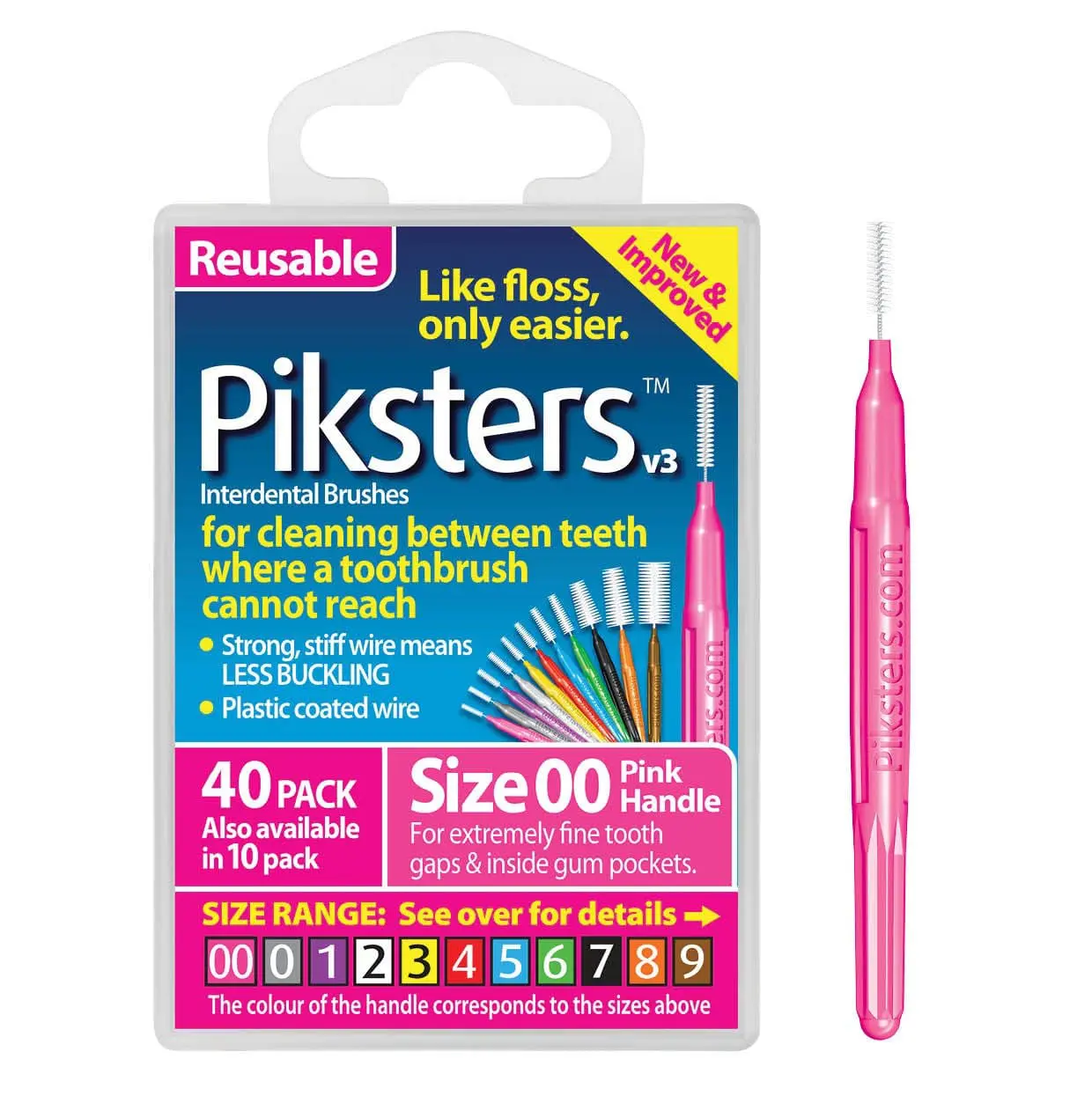
Piksters are hand-held interproximal brushes intended for patient homecare as an adjunct to usual tooth brushing. They can also be utilized for cleaning around orthodontic braces or splints. The brushes are made of nylon filaments mounted into a plastic-coated wire core with a plastic handle. The slim, round handle is designed to be “twisted” to ease insertion and aid with removal of debris. The brush end may be bent to facilitate access to all proximal surfaces. Piksters are made in eight color-coded sizes with replaceable plastic caps. They are packaged in transparent envelopes in the configurations of: 8 pack – one of each size 0-7; 10 pack of one size; 40 pack of one size, for the dental professionals; a hygienist pack of 100 brushes or a professional pack of 200 brushes for dentists in a mix of sizes from 0-7 is available. Patient education brochures are also available on request from the manufacturer and their distributors. Fourteen consultants and 75 of their patients used Piksters over 260 times during the evaluation period.
Product Features
Consultants and their hygienists were all in agreement that Piksters contributed to good oral hygiene. The wide variety of sizes provides most patients with a comfortable experience; however, not all interproximal spaces are large enough to accommodate even the smallest brushes. The color-coding made finding the correct size easy, and the bristle stiffness was determined to be ideal for the majority of users. The wire stem of the smaller sizes requires gentle use to avoid breakage. Orthodontic and periodontal patients found the Piksters to be excellent for keeping brackets and pockets cleaner. Ninety percent of consultants and their patients would recommend Piksters and 91% found them equivalent to or better than the product they are currently using.
Clinical Tips
- To avoid breakage, especially with the small size, bend the wire along its length, not at the handle interface.
- Apply pastes or desensitizers to brush for interproximal application.
- To facilitate insertion in narrow spaces, twist or roll the handle.


