
by Dental Advisor | Jul 2, 2021
Overview
- 10 Clinical Evaluators
- 322 Total Uses
- 86% Clinical Rating
Evaluators’ Comments
- “I obtained faster, more profound anesthesia; especially using Septocaine 4% 1:100K.”
- “Everything about it is fabulous. The patients were very pleased. I have an excellent injection technique and the Dentapen makes it better.”
- “I liked the fact that I could use whatever brand of needles and carpules that I wanted.”
- “I would have liked it to be a little quieter.”
- “I liked the compact size and light weight.”
- “Switching out carpules takes a bit of time as you have to wait for the computerized plunger retraction.”
Indication
- Routine administration of local dental anesthetics
Clinical Tip
- Make sure you talk with your patient to let them know what is going on and the sounds you will hear is normal, as it is not something they’re used to.
Description
Dentapen electronic syringe
- Cordless and battery-operated
- 3 injection speeds for better management of your injections
- Fast: 1mL/30s
- Medium: 1mL/60s
- Slow: 1ml/90s
Unique Attributes
- Computerized local anesthetic delivery device in the palm of your hand with no foot pedals, consoles or cords.
- Two different handles allow you to hold more like a traditional syringe or with a pen-style.
- Compatible with the standard anesthetic cartridges
- Self-aspiration feature.

by Abigail | Jan 4, 2019
Consultants’ Comments
- “Easy to see the remaining anesthetic, and listen to the auditory beep for speed/pressure.”
- “I really liked the small footprint and high-tech look of the unit.”
- “Easy to set up and load/unload.”
- “No extra disposable tubing to deal with.”
- “Every single patient loved it.”
- “Injections take longer time in fast mode than from a standard syringe.”
- “Modes 2 & 3 did not give me the flexibility to switch speed fast enough.”
- “Some patients stated that they felt no difference with the CALAJECT compared to a syringe.”
- “Simple concept, great ergonomics without thumb pain or contortion.”
Clinical Tips
- Be patient, it’s not as fast as a traditional injection technique. Technique mirrors the recommended injection times from academic sources, slower than in most clinical environments.
- Process gets easier after 10 to 15 uses.
- Still use topical/benzocaine prior to use.
- Adjust the volume of the “beep” so it is not too loud or distracting for the patient, and make sure that the cords are appropriately placed to prevent catching on the patient, doctor or assistant.
- The unit has to be set up in the right place to be efficient, and it takes time to re-load carpules for the doctor.
Evaluation Highlights
CALAJECT was evaluated by six consultants and used 153 times in total.
- Ergonomic unit with small footprint
- Good visual displays and auditory signal
- Controls flow of local anesthetic
- Automated aspiration
Unique Features
- Vibration-free, tactile handpiece
- User-friendly touch controls
- Display of actual injection pressure
- Auditory signals indicating anesthetic flow rate
- Automated aspiration and automated shut-off
Description
CALAJECT is a computer-assisted local anesthesia device designed to help the clinician administer pain-free injections. The system controls the flow rate of the local anesthetic, delivering it smoothly and gently. The handpiece is designed to be vibration-free, tactile, and uses standard needles and anesthetic carpules. Its light pen grip provides a relaxed working position and good finger support. The control unit has a separate foot control and user-friendly touch controls. It displays the injection pressure, includes auditory signals indicating the flow rate, and incorporates an automatic shut-off for situations with excessive resistance. The carpule is visible during use, and easing pressure applied to the foot control provides for automated aspiration. CALAJECT is available in a kit containing one handpiece, a stand for the handpiece, a foot control, three cartridge barrels, and a charger.
by Abigail | Nov 30, 2010
Consultants’ Comments
Description
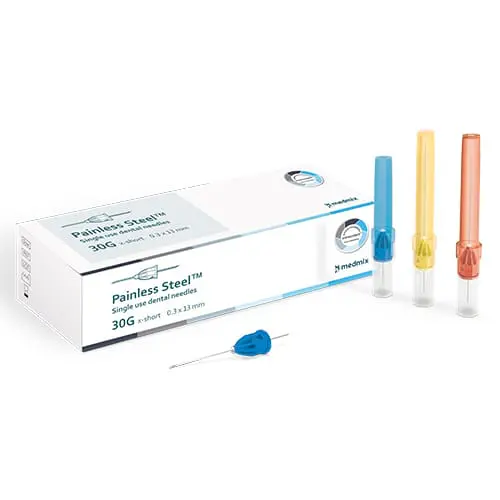
transcodent Painless Steel Dental Injection Needles are single-use, sterile needles for the delivery of anesthetic. Each needle has a three-edge lancet grinding and a siliconized cannula for smooth entry and patient comfort. Each hub has a bevel marking and is threaded to ensure easy and safe handling. The needles are to be used with imperial thread injection syringes. To use, bend the cap to break the heat seal, and remove the back-cap. Screw the needle on an anesthetic syringe and pull off the front cap. Note the bevel mark for optimal needle point location during injection. transcodent Painless Steel Dental Injection Needles are available in 25 G short/long, 27 G short/long, and 30 G short/x-short. Twenty-six clinical consultants used these injection needles in over 900 procedures. This product received a 95% clinical rating.
Product Features
Overall, clinical consultants found the characteristics of transcodent Painless Steel Dental Injection Needles superior compared to their current brand of injection needles. Patient comfort and smoothness of the injection were among the highest rated characteristics. The sharpness of the bevel, in combination with the good stiffness of the siliconized cannula, allows for smooth entry into tissue with improved comfort to patients. No problems were reported with the fit of the needle to the syringe or removal from the syringe. Ninety-one percent of consultants rated transcodent Painless Steel Dental Injection Needles equivalent to or better than their current injection needle, 70% indicated they would switch, and 78% would recommend transcodent Painless Steel Dental Injection Needles to their colleagues.
Editors’ Note: The manufacturer will be printing the needle measurements onto the cap in gauge (e.g. “G27 long”).


