“Very versatile, highly esthetic material. I use it for most of my anterior and posterior restorations.”
Description
IPS e.max Press (Ivoclar Vivadent) is a high-strength, lithium disilicate ceramic used for anterior and posterior restorations as well as anterior three-unit bridges. IPS e.max Press can be overlaid with IPS e.max Ceram to optimize esthetics. This product received a 97% clinical rating.
Clinical Evaluation Protocol
• Four dentists placed 671 IPS e.max restorations in 282 patients over a five-year period. • Three hundred eighty-one restorations were evaluated (Figure 1). • Sixty-eight percent of these were in function for five years while the remaining 32% were in function for less than five years (Figure 1). The restorations represented a variety of anterior and posterior crowns as well as inlays and onlays (Figure 2). • Before cementation the internal surfaces of all restorations were etched with 5% hydrofluoric acid gel for 20 seconds, then rinsed and coated with a silane (Monobond Plus). All were cemented with either self-adhesive resin or esthetic resin cements (Figure 3). Esthetics, resistance to fracture or chipping, resistance to marginal discoloration, lack of sensitivity, and retention were evaluated and rated on a 1 to 5 scale (1=poor, 2=fair, 3=good, 4= very good, 5= excellent).
Results at Five Years
Esthetics Ninety-seven percent of the IPS e.max Press restorations received a five or an excellent rating (Figure 4). The restorations were not only clinically acceptable but also of superior esthetic quality. Many patients remarked positively on the esthetics of the restorations. Figure 5 shows an IPS e.max Press onlay at five years. Only 6% of the restorations were slightly opaque and lacked sufficient translucency, which could be a function of ingot selection.
Resistance to Fracture/Chipping Of the 381 restorations evaluated, seven fractured and were replaced over the 5 year period (Figure 4). Only 1.5% of the restorations exhibited some chipping and these were smoothed and polished. Less than 2% fractured and were replaced. This fracture rate is less than half the average fracture rate of ceramics documented by THE DENTAL ADVISOR over the past 27 years.
Resistance to Marginal Discoloration The lack of marginal discoloration of the restorations was excellent in 96% of the cases (Figure 4). Leakage at the margins is not just related to the fit but more to the bonding and the resin cement. In 2% of the recalled cases, some graying at the margins was noted but none necessitated their replacement at five years.
Lack of Sensitivity Only seven cases (1.5%) of postoperative sensitivity were reported by patients (Figure 4). All except for one were mild in nature and subsided over time.
Retention Twelve restorations (4%) debonded and needed to be recemented (Figure 4). This debonding rate is similar to debonding rates of other all-ceramic restorations monitored over 27 years by THE DENTAL ADVISOR and is related to the preparation and the cement rather than the ceramic.
Summary
IPS e.max Press has proven to be a very esthetic, high-strength, durable material with excellent clinical performance over the five years. Its performance has exceeded that of traditional PFM restorations as well as many all-ceramic restorations. IPS e.max Press is highly recommended by THE DENTAL ADVISOR.
Herculite™ Ultra is a nanohybrid composite available in both bulk syringe and unidose delivery systems. It is a light-cured material designed for direct placement of all anterior and posterior composites with a wide variety of Enamel and Dentin shades available, including XL Enamel Shades for bleached and deciduous teeth and light incisal shades for a high level of translucency. Optibond™ XTR is a self-etch universal adhesive system that includes a self-etch primer and adhesive. It is available in bottle and unidose delivery systems and can be utilized for both direct and indirect restorations. It is compatible with all composites, self-cured and dual-cured resin cements and core materials. OptiBond™ XTR can also be used to prime metal, ceramic, and composite substrates, resulting in an improved bond.
Clinical Evaluation Protocol
During a five-year period, 165 restorations were placed with Herculite™ Ultra and Optibond™ XTR by four dentists. One hundred fifty-eight restorations were used in posterior teeth, with seven being placed in the anterior region.
Results at Five Years
Of the 165 restorations that were recalled, 64 were in function for four years and 101 were in function for five years. The recalled restorations were evaluated for: esthetics, resistance to fracture/chipping, resistance to marginal discoloration, wear resistance, and lack of postoperative sensitivity as reported by patients.
Clinical Observations
Esthetics
Esthetics was rated excellent. The vast majority of restorations blended very well with the surrounding tooth structure. Five percent of the restorations were judged to be opaque.
Resistance to Fracture/Chipping
Resistance to fracture/chipping was rated excellent. During the evaluation period, 9 of 165 restorations were noted to have fractured or chipped, four of which were large restorations and required replacement with crowns. All restorations that experienced fracture or chipping were in posterior teeth. None of the chipped restorations required replacement and all fractures/chipping occurred at 4-year recall or after.
Resistance to Marginal Discoloration
Resistance to marginal discoloration was rated excellent. One restoration (#15 MOD) was replaced with a crown due to recurrent decay unrelated to the composite. Another restoration had staining at the margin, which was successfully removed by repolishing it.
Wear Resistance
Wear resistance was rated excellent, with only one restoration requiring replacement at two years because the patient was a heavy bruxer and the opposing tooth had a zirconia crown.
Lack of Postoperative Sensitivity
Lack of postoperative sensitivity was rated excellent. Only one report of sensitivity was noted at a one-year recall and the sensitivity subsided later.
Summary
Herculite™ Ultra and Optibond™ XTR performed well at the five-year recall. Restorations received excellent ratings for esthetics, resistance to fracture/chipping, resistance to marginal discoloration, wear resistance, and lack of postoperative sensitivity as reported by patients. Herculite™ Ultra and Optibond™ XTR received a 98% clinical performance rating at five years.
“Definitely my favorite material when it comes to handling and shaping posterior composites.”
“Retains esthetics and polish over time.”
“Amazing resistance to wear even after eight years.”
“Best handling posterior composite.”
Description
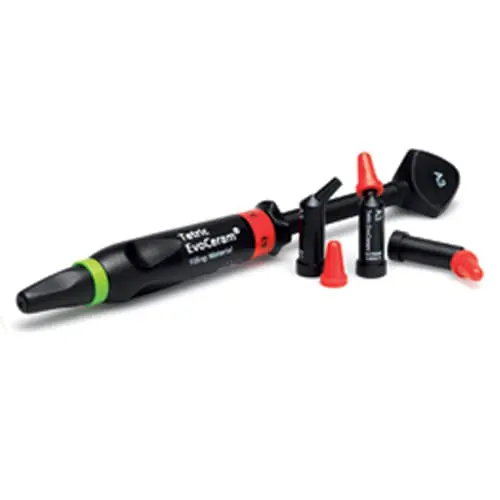
Tetric EvoCeram is a universal, hybrid composite indicated for anterior and posterior esthetic restorations. The composite is radiopaque and formulated to meet any rigorous esthetic challenge with availability in Enamel, Dentin, and bleach shades. This light-cured composite consists of particles ranging in size from 40 to 3000 nm with an average particle size of about 550 nm. It is packaged in 0.2 g, color-coded, unit-dose capsules and 3 g color-coded syringes.
Clinical Evaluation Protocol
873 restorations were placed and monitored over an eight-year period.
637 (73%) of these restorations were recalled over a six-month period. The restorations included both anterior and posterior teeth (Figure 1).
The recalled restorations were Classes I, II, and Class IV composites (Figure 2).
Timeline of restorations in clinical service is shown in Figure 3.
At recall the following categories, esthetics, resistance to fracture/chipping, resistance to marginal discoloration, and wear resistance were rated on a scale of 1 to 5 with 1=poor, 2=fair, 3=good, 4=very good, 5=excellent. Any restoration receiving a rating of 1 or a 2 in a category is automatically replaced. Restorations receiving a rating of 3 or 4 in a category are still clinically acceptable and are not replaced.
Clinical Observations
Esthetics The esthetics of Tetric EvoCeram was excellent at recall (Figure 4). Out of 637 recalled restorations, 93% received an excellent rating and 7% received good to very good rating and did not require replacement. Only three restorations (0.5%) required replacement because of poor esthetics. Tetric EvoCeram layered with a translucent shade often resulted in improved esthetics, opalescence and translucency. Layering is especially important in teeth that are discolored.
Resistance to Fracture and Chipping Over 95% of the 637 recalled Tetric EvoCeram restorations received an excellent rating (Figure 4). 2% of the restorations had chipped but did not require replacement, while 3% or 19 restorations did need to be replaced. Tetric EvoCeram proved to be very resistant to fracture and chipping at 8 years, especially given that 96% of the restorations were posterior restorations and were subjected to high occlusal forces.
Resistance to Marginal Discoloration Microleakage is affected by both the composite and the bonding agent. Excessive microleakage can lead to decay or poor marginal esthetics. 86% of the recalled restorations had no visible microleakage and were rated excellent (Figure 4). 13% had slight to medium microleakage, while 1% had excessive microleakage which necessitated the replacement of the restoration. A variety of self-etch (88%) and total-etch (12%) bonding agents were used.
Wear Resistance 98% of the restorations showed no evidence of wear and received and excellent rating, whereas 1.5% of the restorations received a good or very good rating (Figure 4). Only 0.5% of the restorations required replacement because of excessive wear.
Conclusions
Tetric EvoCeram has excellent handling characteristics. It is non-slumping, not sticky, contours well, and is easy to finish and polish. This eight-year evaluation of 637 restorations demonstrated that Tetric EvoCeram had superior performance in esthetics, resistance to fracture/chipping, resistance to marginal discoloration, and wear resistance. Tetric EvoCeram received a 97% clinical performance rating.
Ask Dr. Farah
Dr. John Farah has watched the evolution of many dental materials from a clinical and laboratory perspective since 1965. We have asked him to share his experiences in hopes that we can gain a greater appreciation for the changes that have occurred and understand the trends we are seeing today.
What changes in composites do you feel have most dramatically impacted dentistry over the past 30 years?
Modern composites definitely have better handling, resulting in easier placement. I prefer composites that are somewhat condensable – more viscous and more highly fi lled – resulting in easier contouring and development of anatomy. I want a composite that is easy to shape and will maintain its form but not drag. Good examples are Tetric EvoCeram (Ivoclar Vivadent) and Aura [SDI (North America) Inc.]. Modern composites also have better wear characteristics and excellent shade stability. I just observed a Tetric EvoCeram composite where there was no detectable wear and the shade was perfect after 10 years. Because of the very small size of filler particles, modern composites polish well and retain their gloss over time too. The strength properties are outstanding; it is rare for a clinician to see an actual fracture of a composite.
“My material of choice when doing anterior cosmetic bonding.”
“Definitely a great handling material for both anterior and posterior restorations. Great opalescence and translucency allow it to blend very well with surrounding tooth.”
“Looks great after 5 years, and I am sure it will last much longer.”
Description
Estelite Sigma Quick is a supra-nano filled, low shrinkage, universal composite indicated for anterior and posterior restorations. Estelite Sigma Quick uses the RAP technology (Radical-Aplified Photopolymerization initiator technology) that offers increased working time of 90 seconds under ambient light and decreases curing time to 10 seconds. Estelite Sigma Quick is available in both syringes and preloaded tips in about 20 different shades.
Clinical Evaluation Protocol
Over 2800 Estelite Sigma Quick restorations were placed and bonded with a variety of 6th- and 7th-generation bonding agents.
1511 anterior and posterior restorations (Figure 1) composed of one, two, three and four surfaces (Figure 2) were recalled.
The restorations were in service from less than 3 years to more than 6 years (Figure 3).
At recall, restorations were evaluated for resistance to fracture/chipping, esthetics, resistance to marginal discoloration, wear resistance, and retention.
Restorations were rated on a 1-5 scale: 1=poor, 2=fair, 3=good, 4=very good, 5=excellent.
Clinical Observations
Resistance to Fracture/Chipping Estelite Sigma Quick performed extremely well with regard to resistance to fracture and chipping over the five-year period (Figure 4). 39 restorations (2.6%) had small chips, but did not require replacement. Another 18 restorations (1.2%) fractured and were replaced. Many of the restorations replaced were large, and in several cases, the tooth fractured requiring the placement of a crown.
Esthetics The esthetics of Estelite Sigma Quick was excellent (Figure 4). In many cases the fillings were hard to detect and blended with the teeth perfectly. The availability of many shades and opacities was extremely helpful in achieving long-lasting results.
Resistance to Marginal Discoloration Most of the Estelite Sigma Quick restorations were bonded with 6th- or 7th-generation bonding agents. 97% of the restorations exhibited very slight or no microleakage at the margins at recall time (Figure 4).
Wear Resistance Estelite Sigma Quick maintained excellent wear resistance in both the anterior and posterior regions after five years in function (Figure 4). The wear on the opposing dentition was minimal.
Retention Retention was excellent (Figure 4). There were 33 debonds (2.2%) that involved facial/buccal surfaces. Debonding was more a function of the bonding agent and surface preparation and not the composite.
Summary
Among over 1500 Estelite Sigma Quick recalled restorations, the vast majority performed exceptionally well over the 5-year period. The composite has excellent translucency that helps it blend very well with the surrounding tooth structure. The material sculpts very easily especially when cosmetically bonding anterior composites. Estelite Sigma Quick received a clinical performance rating of 96%.
“Versatile composite – works everywhere in the mouth.”
“Reliable restorative material.”
“Holds its polish.”
Description
Venus Pearl is a universal, nano-hybrid composite based on the chemistry of Venus Diamond but with a creamier consistency. Venus Pearl is suitable for all classes of anterior and posterior restorations and is designed to produce a durable, highly esthetic result with a long-lasting, high luster polish. Venus Pearl is available in both syringe and unit dose (PLT) delivery in 27 shades. iBOND Total Etch is a light-cured adhesive used in conjunction with phosphoric acid etchant. It contains nanofillers in an ethanol solvent and can be applied as one coat. iBOND Self Etch is a light-cured, self-etching, one-component bonding agent. Light curing time for both adhesives is 20 seconds. iBOND is available in both 4 mL bottles and single-dose delivery.
Purpose
The purpose of this evaluation was to monitor the one-year clinical performance of Venus Pearl restorations bonded with iBOND Total Etch and iBOND Self Etch.
Clinical Evaluation Protocol
• 190 Venus Pearl restorations were placed; 169 restorations were recalled during the first year after placement. • Anterior and posterior restorations were placed (Figure 1). • Restorations were bonded with iBOND Total Etch and iBOND Self Etch (Figure 2). • At recall, restorations were evaluated for resistance to fracture/chipping, esthetics, resistance to marginal discoloration, wear resistance, lack of sensitivity, and retention. • Restorations were evaluated on a 1-5 rating scale: 1 = poor, 2 = fair, 3 = good, 4 = very good, 5 = excellent.
Clinical Observations
Resistance to Fracture/Chipping Resistance to fracture and chipping was excellent with Venus Pearl (Figure 3). Of the 169 restorations recalled, only one, a Class II filling on a second molar, fractured and required replacement. No chipping was observed.
Esthetics Esthetics of Venus Pearl was rated excellent in both anterior and posterior applications (Figure 3). Resistance to Marginal Discoloration Venus Pearl exhibited excellent resistance to staining at the margins of the restorations (Figure 3). Five of the recalled restorations (3%) showed marginal staining. Four of these were minor, requiring no treatment; one involved recurrent caries at the margin. Wear Resistance No visible signs of wear were noted on the Venus Pearl restorations recalled (Figure 3). Lack of Sensitivity When patients were questioned about sensitivity at their recall appointments, excellent results were reported (Figure 3). There was only one instance of sensitivity – a Class II Venus Pearl/iBOND TE restoration was replaced and an area of incomplete bonding was discovered at that time. Retention The overall retention rate of the Venus Pearl restorations in this evaluation was 99% (Figure 3). Two Class V restorations on second molars (on the same patient) debonded. These restorations were bonded with iBOND TE and were found to be missing nine months after placement. The other restorations were intact.
Conclusions
Venus Pearl used with iBond Total Etch and iBond Self Etch received excellent ratings for resistance to fracture/chipping, esthetics, resistance to marginal discoloration, wear resistance, lack of sensitivity, and retention at one year. Venus Pearl/iBond received a 99% clinical performance rating.