“Plastic mandrels in each packet are great! No more hunting for the few metal mandrels in the office.”
“No metal in the center of the disk is great!”
Description
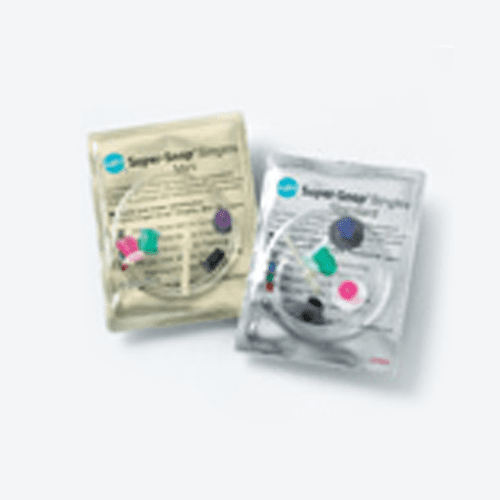
Super-Snap Singles are thin, flexible disks with a silicone rubber center. The plastic, latch-type mandrel is disposable. Super-Snap was previously evaluated in THE DENTAL ADVISOR PLUS, Vol. 6, No. 2, March/April 1996. This new packaging of Super-Snap is designed to enhance office asepsis. Each Super-Snap Singles individual sterile pack contains a plastic mandrel plus 8 disks: coarse, medium, fine, and extra-fine grits in both regular (12.5 mm) and mini (7.94 mm) sizes. The disks are color-coded for easy identification: black (contouring), violet (finishing), green (polishing), and red (super polishing). They are doublesided with an abrasive on both sides except for the coarse grit disk, which is single-sided. The disks are designed for use in a slow-speed handpiece at 10,000-12,000 rpm. Twenty-four consultants evaluated Super-Snap Singles in over 550 uses.
Super-Snap Single are individually packaged abrasive disks excellent for contouring, finishing and polishing composite restorations. They received a 96% rating.
Product Features
Super-Snap Singles were rated excellent for their ease of use and quality of final polish. Ninety percent of consultants rated Super-Snap Singles the same as or better than the product they were currently using. Seventy seven percent of consultants stated that they would both purchase and recommend Super-Snap Singles.
Clinical Tips
Use light pressure.
Can be used to contour natural teeth.
The mini size adapts well to the lingual surfaces of maxillary incisors.
Editors’ Note:
Super-Snap Singles are now available in mini packs with the mini-size disks in all grits and a plastic mandrel, as well as standard packs with the regular-size disks in all grits and a plastic mandrel.
“I love the putty – it has a good texture and is not sticky.”
“Great to have some control of the working time.”
“Very little force is required to dispense material from the gun.”
“The product label covers the entire cartridge, masking the amount of material remaining.”
“The tray adhesive is too runny.”
Description
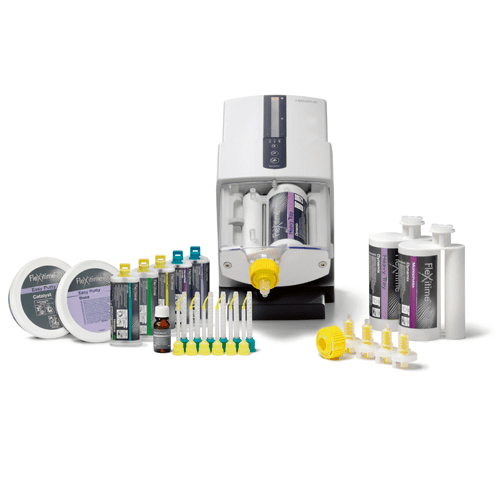
Flexitime is a hydrophilic, addition silicone impression material, which is available in the following viscosities:Light Flow – extra-light body, Correct Flow – light body, Medium Flow – regular body, Monophase, Heavy Tray – heavy body, and Easy Putty. Most viscosities are available in 50 ml cartridges, and the putty is supplied in 600 ml tubs. Heavy Tray and Monophase are also available for use with the Flexitime Dynamix automatic mixing delivery system. The trial kits contains sufficient material along with mixing tips and tray adhesive. Flexitime has a unique formula that allows a range of working times from 30 seconds to 2:30. The set is accelerated by mouth temperature and the set time is 2:30 after insertion. Eight consultants evaluated Flexitime in 115 clinical cases. This product received a 97% clinical rating.
Product Features
The multiple viscosities and the ease of delivery of Flexitime were rated as excellent. The material injects easily and has good flow. None of the cartridges exhibited any clogging in the tips. Dental assistants found the putty to be one of the easiest to mix. Upon seating the tray, the putty is soft enough to adapt to the teeth without distortion, resulting in excellent fit of restorations. The flexibility in the working time is an advantage for multiple-unit impressions, while for single-unit impressions, the working time is reduced, because the material sets rapidly at mouth temperature. Correct Flow light body blends well with the heavy body and putty with sufficient color difference for easy reading of the margins. Eighty-eight percent of consultants would both purchase and recommend the Flexitime system.Editors’ Note: The original evaluation was published in THE DENTAL ADVISOR, Vol. 18, No. 3, April 2001.
“I like the quick setting with the light-cured option.”
“Nice temporary material.”
“Polishes to a smooth finish.”
“Material is quite translucent.”
“Sticks to core material.”
Description
Integrity® Multi-Cure temporary crown and bridge material is a dual-cured bis-acryl material with increased strength that is intended for short- or long-term provisional restorations. Integrity Multi-Cure has a working time of 45 seconds and an initial setting time of 90 seconds after start of mix. After removal from the mouth, final curing is 5 minutes if self-cured or 20 seconds if light cured. Integrity Multi-Cure is available in a 76 g, 10:1 black cartridge in five shades: A1, A2, A3.5, B1, and BW. The introductory kit includes one A2 cartridge of Integrity Multi-Cure material with 15 mixing tips and a dispenser plus Integrity® TempGrip® temporary crown and bridge cement. Integrity Multi-Cure was evaluated by 11 consultants in 197 uses. This provisional material received an 86% clinical rating.
Product Features
The light-curing option of Integrity Multi-Cure allows the clinician to trim and polish the provisional restoration without waiting for self-cured setting. After curing, the material sets very hard and can be trimmed without chipping margins. Shade selection is adequate for most cases. The esthetics of the provisional restorations is influenced by the translucency of the material, which can be an advantage or a disadvantage depending on the particular case. Integrity Multi-Cure dispenses uniformly through the mixing tip. An air-inhibited layer must be wiped from the provisional restoration and the adjacent teeth after removal of the provisional from the mouth. Consultants noted some shrinkage of temporary crowns and bridges during setting. Twenty-seven percent of consultants found Integrity Multi-Cure to be better than other provisional materials they had used; 46% found it to be equivalent. Thirty-six percent would switch to Integrity Multi-Cure and 64% would recommend it.
Clinical Tips
Do not light cure the material in the mouth. The material sets very hard and may lock into undercuts and embrasures.
“Doesn’t seem to evaporate as quickly as Prime & Bond 2.1.”
“I could not tell much difference between this material and Prime & Bond 2.1.”
“Some consultants disliked the acetone smell.”
Description
Prime & Bond NT is a self-priming, light-cured bonding agent that contains nanofillers of amorphous silicone dioxide, which differentiates this product from Prime & Bond 2.1. In addition to the nanofillers, Prime & Bond NT is primarily composed of di- and tri-methacrylate resins, PENTA (dipentaerythritol penta acrylate monophosphate), and contains an acetone solvent. It combines both the primer and adhesive in a single bottle and requires one application followed by a 10-second light cure. Prime & Bond NT is designed to bond composite materials and compomers to enamel and dentin. It is also indicated for the bonding of veneers, composites and ceramics, as well as an adhesive cavity varnish for amalgam. The introductory kit contains one, 4.5-ml bottle of adhesive, 40 disposable brush tips, an applicator brush handle, a re-usable well, an instruction booklet, and a laminated instruction card. The introductory kit does not contain an etchant; however, the economy kit contains three, 4.5-ml bottles of adhesive, one syringe of etching gel and accessories. Twenty-two consultants evaluated Prime & Bond NT in over 450 clinical cases. This product received a 91% clinical rating.
Product Features
Prime & Bond NT was highly rated for its instructions and ease of coating the preparation. Consultants found the system easy to use, and they appreciated the single-bottle, one-step system. The squeezable bottle and good flow of the adhesive contributed to the ease of dispensing. In addition, no bonding problems were reported over the three-month evaluation period. The majority of consultants found Prime & Bond NT to be equivalent to or better than their current adhesive and indicated that they would switch to it. Eighty-two percent of consultants would purchase Prime & Bond NT, and 94% would recommend it.
Bond Strength to Tooth Structure, MPa
Enamel
Dentin
Prime & Bond NT
28
22
Clinical Tips
Do not dispense until ready to apply to avoid evaporation of solvent.
Eugenol-containing materials should not be used with Prime & Bond NT, because they may interfere with the polymerization of polymeric components.
Editors’ Note: The original evaluation was published in THE DENTAL ADVISOR, Vol. 17, No. 1, January-February 2000.
Cerpress SL is a low-fusing, leucite-reinforced ceramic system indicated for anterior and posterior crowns, inlays/onlays and veneers. Restorations may be completely made of Cerpress SL or a Cerpress SL core may be overlaid with Sensation SL low-fusing porcelain and stains. Both contain leucite particles of 2-4 microns, dispersed in a glass matrix. Cerpress SL pressable ingots are available to the laboratory in a variety of shades and translucencies, allowing the treatment of a wide range of clinical conditions. > Highly Translucent – used with a light preparation color or with inlays/onlays to reflect the inner tooth color. > Medium Translucent – designed for lighter shades, including the “Hollywood” shades; indicated for veneers and masking dark preparations. > High Opacity – developed to mask very dark preparations, posts and tetracycline stain. Shades available include all Vita shades plus translucent shades and “Hollywood” shades (A0, A00, B0 and B00) that are lighter than Vita B1. Cerpress SL received a 98% clinical rating.
Clinical Evaluation Protocol
A total of 545 Cerpress SL restorations were placed in 151 patients and evaluated at insertion.
Restorations included crowns, inlays/onlays, and veneers on 91 molars, 80 premolars and 374 anterior teeth.
All restorations were seated with adhesive resin cements. 415 restorations were recalled for evaluation, ranging from 1 to 5 years in service (Figure 1).
Restorations were evaluated on a 1-5 rating scale: 1=poor, 2=fair, 3=good, 4=very good, 5=excellent.
Categories evaluated at insertion: • Overall laboratory product • Shade match • Vitality • Fit of restoration • Margin integrity • Ease of adjustment/polish
Categories evaluated at recall: • Resistance to fracture/chipping • Shade match/esthetics • Vitality • Lack of marginal discoloration • Wear resistance • Patient satisfaction
Clinical Observations
Insertion
Ratings at insertion were very high, with 94% or more of the restorations receiving excellent ratings in each category (Figure 2). No ratings below 4 were noted. Cerpress SL produced excellent, life-like appearance with shades true to those requested. Over 99% of the restorations exhibited excellent fit and margins upon seating. Only minimal adjustments were required, and the ability to regain a high polish rated excellent in all cases.
Recall
Resistance to Fracture/Chipping > After 5 years, over 98% of Cerpress SL restorations were fully intact (Figure 3). During the evaluation period, 8 restorations required replacement due to complete fracture: 4 anterior crowns at 1 year, 1 molar crown at 2 years, and 2 veneers plus 1 molar crown at 3 years.
Shade Match/Esthetics and Vitality > Restorations maintained their esthetic appearance with no loss of gloss, shade change or staining (Figure 3).
Lack of Marginal Discoloration > Restorations rated excellent for absence of marginal staining in 89% of cases (Figure 3). Eleven percent of the restorations showed slight microleakage, noted as black/gray stain visible at the ceramic margins. The majority of these were in anterior restorations, one of which was replaced due to marginal staining.
Wear Resistance > One hundred percent of restorations rated excellent for wear resistance upon visual inspection (Figure 3).
Patient Satisfaction > High patient satisfaction reflects the excellent ratings received in the other categories evaluated (Figure 3). Ninety-six percent of Cerpress SL restorations rated excellent for comfort and appearance, based on patient response.
Summary
Cerpress SL is an excellent pressable ceramic system for single-unit, metal-free restorations.
Clinical Tips
Communication with the laboratory technician regarding desired appearance is critical to a successful case.
A description of the preparation or “stump” shade will help the technician choose the proper translucency of material.