“The easiest cement on veneers we have ever used.”
“Very hard set even without using the light for the dual-cured cement.”
“I thought the light-cured cement was too thick.”
“The light-cured syringes seemed small.”
“Make this product with an angled tip adapter for placement.”
Description
NX3 Nexus Third Generation is a light- and dual-cured esthetic resin cement that is compatible with both total- and self-etch adhesives. It contains nano-fillers for improved handling and polishing properties. The choice of delivery system includes an auto-mix, a dual-cured cement (base/catalyst) and a single-syringe, light-cured (base) for cementation of multiple porcelain laminates. The auto-mixing dual-cured syringe can be used for all indirect cementations including laminates, inlays, onlays, crowns, bridges, posts, and office CAD/CAM-fabricated restorations. The amine-free initiator system provides color stability for both the light- and dual-cured cements for long-term esthetics. The water soluble try-in gels are matched to the light- and dual-cured cements. The manufacturer recommends Optibond Solo Plus and Optibond All-In-One adhesives with NX3. The kit contains one each of the following in shades of clear, white and yellow: 1.8-g light-cure syringes; 5-g dual-cured, auto-mix syringes; and 3-g syringes of try-in paste. The kit also includes a 5-ml bottle of silane, mixing tips and a laminated technique guide. Twenty-six consultants evaluated NX3 in 307 cementation procedures. This product received a 97% clinical rating.
Product Features
NX3 is packaged with a compact instruction manual and an excellent laminated instruction card, which has large, easy-to-follow illustrations. Ninety-five percent of the consultants responded that they prefer a resin cement kit containing both the light- and dual-cured cement. The delivery system for the light-cured and the auto-mix, dual-cured cement eliminates the need for mixing and allows placement of the cement directly into the restoration. The viscosity and shade selection of both cements work well for all types of restorations. Working and setting time were judged to be very good. Ease of excess cement removal before the final set, esthetics, and lack of postoperative sensitivity were rated as excellent. The cement is compatible with both total-etch and self-etch adhesives. One hundred percent of the consultants found NX3 to be equal to or better than the current resin cement they were using, and 100% would recommend it. Eighty-four percent would switch to NX3 Nexus Third Generation.
“Strong enough, yet easy to remove the temporary.”
“A little sticky and hard to clean off instruments and soft tissue.”
“Some consultants noted hardening of the base in the tube.”
Description
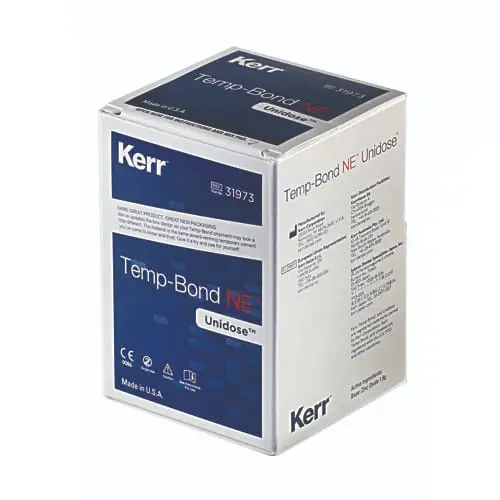
Temp-Bond NE is a two-paste, non-eugenol temporary cement; therefore, it will not interfere with the setting of resin cements. Equal lengths of base and accelerator are dispensed and spatulated. Working time is 1:30; setting time is 4:00 in the mouth. Temp-Bond NE sets relatively hard. A softer set may be achieved by incorporating white petrolatum into the mix. Twenty-six consultants evaluated Temp-Bond NE in cementing more than 900 temporary restorations. This product received a 92% clinical rating.
Editors’ Note: The original evaluation was published in THE DENTAL ADVISOR, Vol. 16, No. 6, July-August 1999.
“Great product for denture patients that are healing after a surgery.”
“Holds up well.”
“This product gives the patient pain-free retention.”
“Include patient pamphlets for home care.”
Description
Sofreliner Tough S is a soft chairside denture lining material. This addition-cured silicone material has a lower hardness than the original Sofreliner Tough M and is intended for use with sensitive or healing soft tissue. It is indicated for use in removable prosthesis with poor retention due to ridge atrophy; pain caused by sharp ridges of bone, undercuts or tori; retention of overdentures before final attachment placement; and as a temporary lining or tissue conditioner. Sofreliner Tough S is provided in an automix cartridge and has a working time of 2:00 minutes and an intraoral set time of 5:00 minutes. The kit contains a 52 g cartridge of Sofreliner Tough S, 10 mL of primer, mixing tips and accessories. Sofreliner Tough S was evaluated by 14 consultants in 62 uses. This chairside soft denture liner earned a 96% clinical rating.
Instructions/Packaging Sofreliner Tough S is provided in a complete kit with all of the items necessary for the clinical procedure. Ten mixing tips are included for multiple applications.
Application Dispensing and application of Sofreliner Tough S are neat and easy with the automix cartridge. The viscosity has enough flow to allow spreading onto the surface of the prosthesis and complete seating in the mouth. Working time is adequate; consultants would prefer a shorter intraoral setting time.
Trimming/Finishing Gross trimming of the material was best accomplished with a scalpel blade or scissors. A rotary abrasive point and a polishing wheel are included in the kit. These are helpful in blending the reline material to the acrylic at the borders.
Quality of Reline Sofreliner Tough S adapted well to soft tissue and produced a very good fit. Ratings for tear resistance ranged from good to excellent, depending on patient factors. Resistance to staining and cracking was rated very good by consultants and patients.
Patient Satisfaction The fit and comfort of was rated excellent by the majority of consultants and resulted in a high level of patient satisfaction. Eighty-three percent of patients reported that Sofreliner Tough S improved the comfort of their prosthesis and 100% would request it again.
Removal Sofreliner Tough S adheres well to denture base material, and consultants experienced some difficulty when removal was necessary.
Clinical Tips
Be sure the primer is completely dry before applying the reline.
Dispense Sofreliner Tough S directly into the denture or partial and spread with a spatula to create an even layer.
Make sure to spread the reline covering all areas where the primer was applied.
Use Silicone Remover (Tokuyama Dental Corp.) to facilitate removal of Sofreliner Tough S from acrylic surfaces.
Luxatemp Fluorescence advances the Luxatemp provisional material line, providing enhanced strength. It is a self-cured composite for the fabrication of temporary crowns and bridges, inlays, onlays and veneers. Luxatemp Fluorescence is also indicated for the fabrication of long-term temporaries. The two-component material is based on multifunctional methacrylates and is automatically mixed. Luxatemp Fluorescence is fluorescent and is available in shades A1, A2, A3, A3.5, B1, and BL. It is available in 76 g automix cartridges with 15 mixing tips and 15-g Smartmix syringes with 10 mixing tips. Luxatemp Fluorescence automix was evaluated by 26 consultants in 586 uses. It received a 91% clinical rating.
Product Features
Luxatemp Fluorescence provides provisional restorations with very good esthetics and excellent polishability. The material dispenses smoothly from the cartridge into the clinician’s matrix of choice. Working time is adequate, even for multiple-unit cases, and setting time in the mouth is quick enough to allow removal after about 1.5 minutes. Upon removal, some sticky residue usually has to be cleaned from the adjacent teeth. Bubbles in the material and voids in the temporaries are minimal, with repair easily accomplished with flowable composite. Consultants noted that the enhanced strength was not relevant for the majority of their needs. They did note that the set material was very hard and sometimes brittle in thin areas. Forty-two percent of consultants reported that Luxatemp Fluorescence was better than their current provisional material and 46% reported it was equivalent. Seventy-three percent would switch to the Luxatemp Fluorescence and 77% would recommend it.
Clinical Tips
Store in a dry place at room temperature.
Insert Luxatemp Fluorescence over the prepared teeth within 45 seconds after start of mixing. Remove the temporary from the mouth during the elastic phase, 1:30-2:30 minutes after start of mixing.
After about 5 minutes from the start of mixing, the temporary can be finished.
Estelite® Sigma Quick is a low-shrinkage, submicron-filled composite for use in both anterior and posterior restorations. This enhanced version of Estelite Sigma implements RAP technology (Radical-Amplified Photopolymerization initiator technology), which offers increased working time of 90 seconds under ambient light, while decreasing curing time to 10 seconds with a halogen light. Estelite Sigma Quick contains 82% by weight of silica-zirconia filler. The composite is available in both syringes and pre-loaded tips (PLTs) in shades A1, A2, A3, A3.5, A4, A5, B1, B2, B3, B4, C1, C2, C3, OA1, OA2, OA3, OPA2 (opalescent), BW (bleach white), WE (white enamel), and CE (clear enamel). This product received a 99% clinical rating.
Evaluation Protocol
Estelite Sigma Quick was evaluated by 21 editors who placed nearly 1200 restorations.
Editors’ Observations
Manufacturer’s instructions/Packaging Editors rated both the packaging and instructions as very good. The instructions are clear and thorough. Packaging is clearly marked and easy to store; however, some editors commented they would prefer having all the shades available in one box. The pre-loaded tips (PLT) are each labeled with the name and shade for easy identification.
Ease of dispensing/Viscosity The ease of dispensing from the PLT is among the highest rated features. It flows well and stays where placed.
Ease of placement/Non-stickiness to instrument The ease of placement and workability of this composite are excellent. Editors liked the packability as well as the capacity to work well with most bonding agents. The lack of stickiness to instruments was also rated very good.
Shade availability/Shade match before and after curing The complete assortment of shades offers superior versatility. The system is comprised of 20 shades, 4 opaque, bleach white, as well as white and clear enamel. Shade matching both before and after curing is excellent with minimal shade shift.
Blending of composite with tooth The composite blends exceptionally well with the surrounding tooth structure. Editors felt the material was not too opaque and had very good translucency.
Radiopacity/ Sensitivity to ambient light The radiopacity was very good. The composite is not overly sensitive to ambient light and has an extended working time compared to the original Estelite Sigma.
Ease of finish, polish/Quality of final polish/Final esthetics Editors reported Estelite Sigma Quick was easy to polish and provided a highly satisfactory finish. Overall they were extremely impressed with the final polish and excellent esthetics of this material.
Clinical Tip
Use a nylon (plastic) instrument for anterior incisal edge/angle restorations when layering shades. The flexibility of the instrument and viscosity of the composite work well together to allow feathering of the composite before curing.