
Consultants’ Comments
- “Using Calset gave me better margins and polish.”
- “Really improves the flow and manipulation of composite.”
- “Works well for anterior composites.”
- “Extra set-up time is needed.”
Description
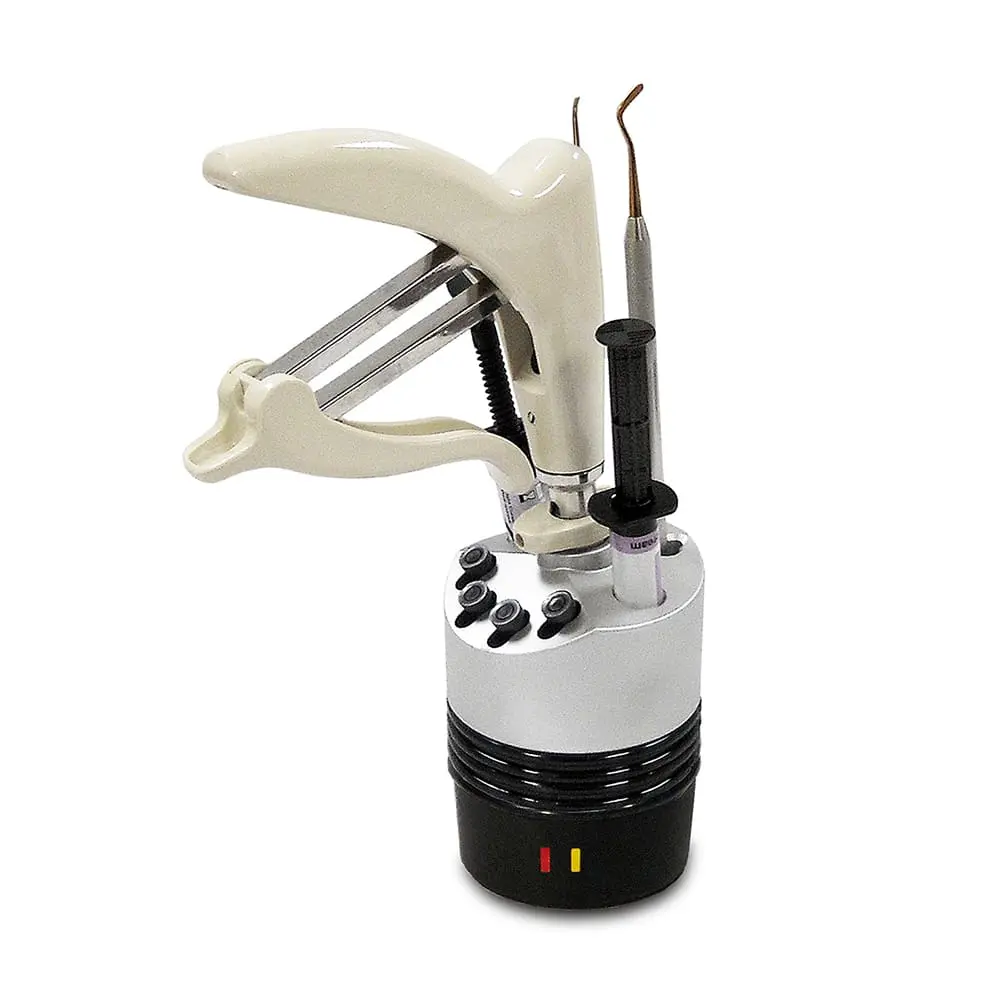
Calset is a heating unit designed to warm resin composites, whitening materials and anesthetics before their application. The use of Calset reportedly increases the flow of resin composites as much as 68%, making them easier to manipulate. In addition, the increased flowability may improve adaptation to tooth structure, decrease polymerization shrinkage and shorten curing time. Calset accepts composite packaged in unit-dose capsules or full-size syringes and is designed for holding a composite gun upright. The product consists of a heating unit, a basic Calset unit with compule holder, a dispenser gun tray, power supply, and instructions. An optional anesthetic tray (holds three carpules) is available separately. Calset requires about 10 minutes to reach the maximum temperature of 155 °F/68 °C. An LED light flashes to indicate that the heating cycle has begun and remains on once the desired temperature is achieved. The LED color corresponds to the desired temperature (green = 98 °F/37 °C, orange = 130 °F/54 °C, red = 155 °F/68 °C). The temperature can be changed by pushing a button. The unit is conveniently transportable and can be disinfected by wiping. Thirteen consultants used Calset in over 200 clinical cases. This product received an 88% clinical rating.
Equipment Features
Consultants found the small size and straightforward design of Calset to be good. Composite capsules and anesthetic carpules are easy to load. Some consultants would have preferred an even greater capacity for continued use of materials throughout the day. Most consultants were able to load the composite dispensing gun into the dispensing gun tray, which is gun-specific (contact manufacturer for more information). The increase in flowability of uncured composite was found to be beneficial to most consultants, although some found that posterior restorations were more difficult to pack. About half of the consultants noted an improvement in finishing and better polishability. While the ability to warm anesthetic was appreciated by many consultants, it was not reported to be consistently beneficial to patient comfort. Sixty-seven percent of consultants would switch from their current routine to Calset and 80% of consultants would recommend Calset for use by a colleague.