
Consultants’ Comments
- “The suspected lesions are certainly well-illuminated.”
- “This product gives rapid results and is easy to use.”
- “This product is a great motivator for patients to have a biopsy done.”
- “Use of this technique shows the patient that I am thorough.”
- “I’d like to read some comparative research studies of Microlux/DL.”
- “The vinegar taste is a drawback.”
Description
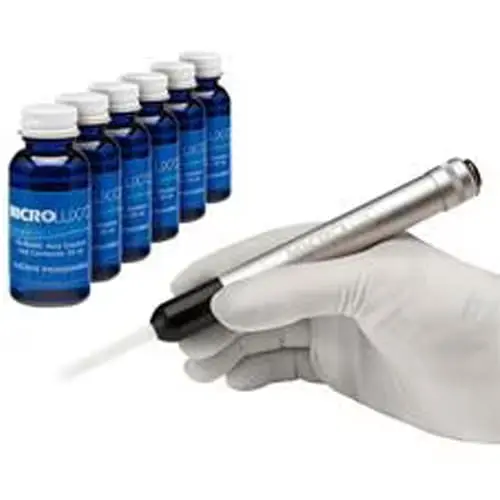
Microlux/DL is a battery-powered LED light intended to enhance visualization of oral lesions as an adjunct to conventional soft tissue examination. The pen-sized unit produces white light through a diffused glass light guide. When the mouth is rinsed with an acetic acid solution, the refractive properties of leukoplakic lesions are changed, making them more visible under the LED light. The manufacturer instructs the practitioner to do a conventional examination with incandescent light, and then follow that with a 60-second rinse of the acetic acid solution and another examination of the area with the Microlux/DL in a dimly lit room. Areas that show an “aceto-white” reaction should be closely monitored or considered for biopsy. The kit has a light with batteries; light guide; and six, 30-ml bottles of 1% acetic acid rinsing solution in a sturdy case. Twelve consultants evaluated the Microlux/DL in 61 oral examinations. This product received an 84% clinical rating.
Equipment Features
Consultants reported that the Microlux/DL is easy to use and readily incorporated into an office routine. The time necessary for the exam is minimal, approximately 3:00-4:00. Patients readily grasped the idea of the technique and appreciated it as a noninvasive screening procedure. It was well accepted by practitioners and patients, although patients found the 1% acetic acid solution to be distasteful. Consultants noted that the best differentiation of “aceto-white” lesions occurred in a dimly lit room. Microlux/DL is not intended to provide a definitive diagnosis; rather, it is a screening tool for lesions that require further investigation. The unit is lightweight and comfortable to use, with very good output. Consultants did not notice appreciable heat generation while the unit was on. Sixty-nine percent of consultants rated Microlux/DL equal to or better than their current technique, 42% would switch, and 72% would recommend it to a colleague.