
Consultants’ Comments
- “This is nice for protection of adjacent composite restorations.”
- “This is a good idea, particularly for dental students.”
- “Case selection is important – easier for small Class II preparations.”
- “Stiff wedge can crush papilla.”
Description
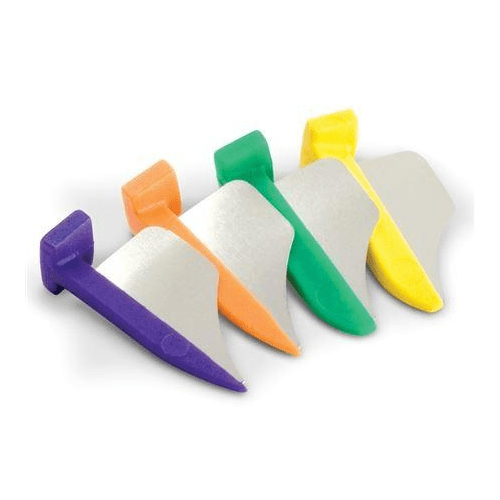
FenderWedge is a combination plastic wedge and protective stainless steel band. The attached 0.08-mm stainless steel band acts as a barrier to protect the neighboring tooth. It is indicated for Class II restorative procedures or other restorative procedures where iatrogenic “nicking” of the adjacent tooth could occur. In addition to protection of the adjacent tooth, it pre-wedges teeth to allow for more conservative preparation and easier matrix band placement. FenderWedge comes in four color-coded sizes: x-small, small, medium, and large. Sizes of the wedges respectively are 1.0 mm, 1.4 mm, 1.9 mm and 2.3 mm, measured occlusal-cervically. Twenty-eight consultants used FenderWedge in over 530 clinical situations. This product received an 86% rating.
Product Features
In theory, consultants found FenderWedge to be an excellent concept. The color-coded system makes it easy to distinguish the various sizes of FenderWedge, and the stainless steel band does a good job of protecting the adjacent teeth. The effectiveness of prewedging teeth in order to more easily place a sectional matrix was found to be fairly limited. Similarly, the pre-wedging did not result in contacts that were significantly improved over usual techniques. It was noted that FenderWedge was more effective at protecting the adjacent teeth in small to moderate sized preparations, but was less effective with larger preparations. Consultants found FenderWedge to be a challenge to place in situations where there was not a large gingival embrasure. In situations where there was gingival inflammation before preparing the tooth, many consultants found that gingival irritation became more extensive after placing FenderWedge. Many consultants commented that they felt that they did not need to protect adjacent teeth due to their ability to control the handpiece, but felt that this would be an excellent product for the relatively inexperienced dentist in helping to prevent iatrogenic damage to the adjacent tooth. Overall, 71% of consultants rated FenderWedge as better than or equal to the current method of protecting adjacent teeth, and 75% of consultants would switch to FenderWedge or recommend it to a colleague.
Clinical Tips
FenderWedge is not indicated for use as a matrix during the placement of restorative material.