Overview
- 4 Clinical Evaluators
- 100 Total Uses
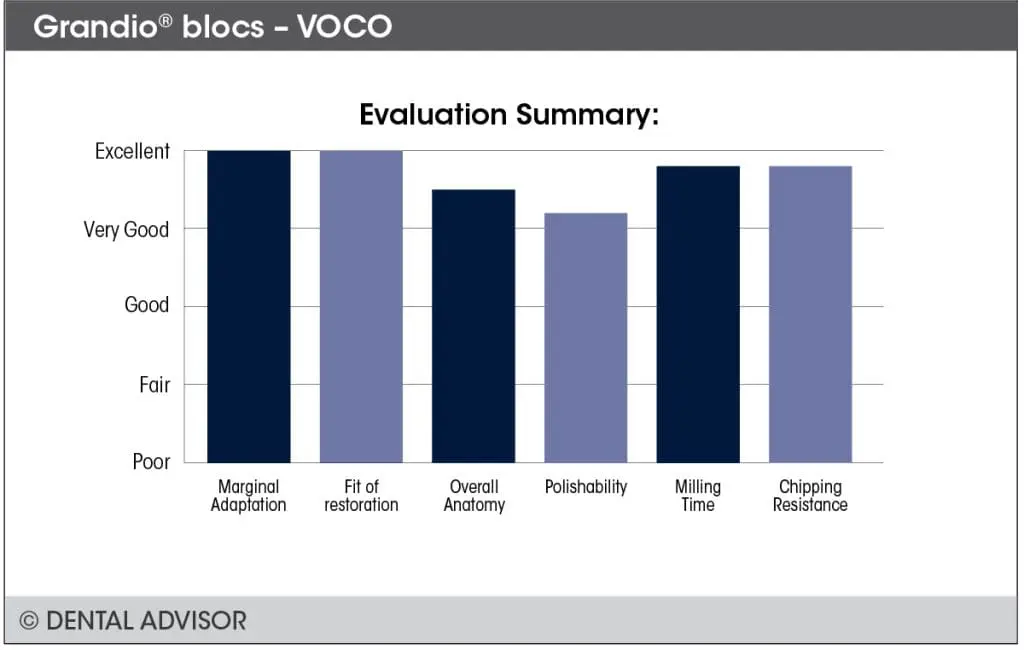
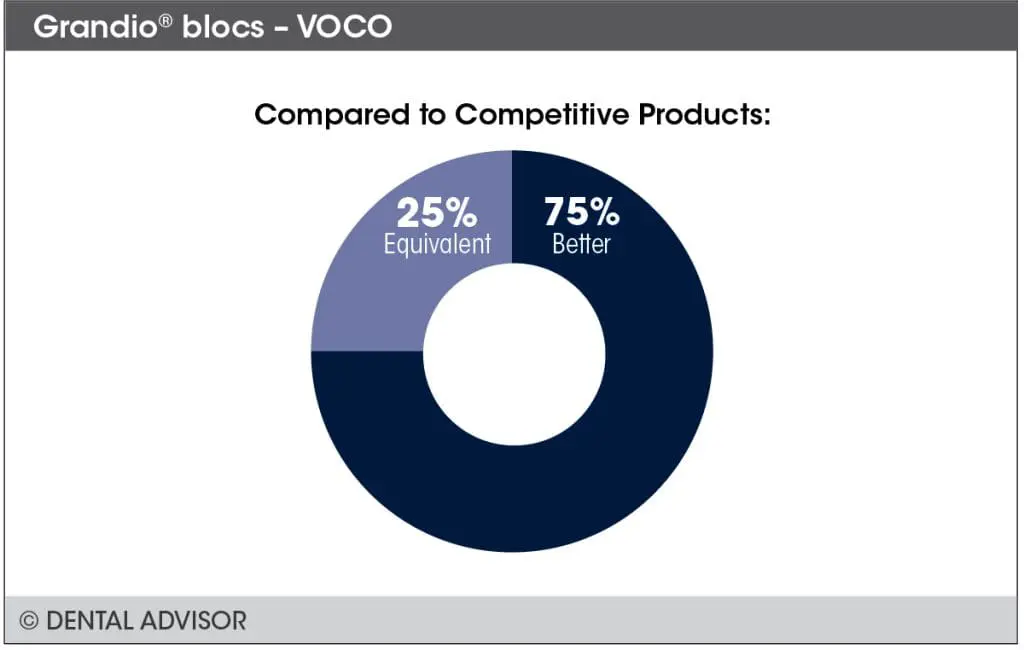
- 96% Clinical Rating
Consultants’ Comments
- “Very fast milling time! Polishability is stunning! Repairs/modifications are easy.”
- “Great for anything pre-molar forward. Material opens up possibilities for more conservative restorations like inlays/onlays.”
- “Their speed of milling is fantastic.”
- “I have been using these blocks in numerous situations and have been able to stain them easily for a very esthetic result.”
- “I would like to see long-term data on performance”
- “Use with caution on patients with allergies to methacrylates.”
- “The anatomy during fabrication, whether on fine or regular speed, didn’t make a difference. Translucency overall was not incredible.”
Description
Grandio Blocs are nano-ceramic hybrid CAD/CAM blocks used to fabricate permanent single-tooth restorations. Restorations are easy to repair and stain with composite material intraorally, if needed. Comes in 7 shades with either a high or a low degree of translucency.

Unique Attributes
- Available in High Translucency and Low Translucency in both 12 and 14L block sizes.
- Veneer preparations can be as minimal as 0.4 mm, while buccal walls of a crown preparation can be as thin as 0.8 mm.
- Material is pre-cured nano-ceramic hybrid material that does not require a sintering or crystalizing procedure. Material is milled quickly and is not to be fired, thus saving valuable time.
- Able to modify or repair fractures and chipping with a composite material intraorally.
- Quick finishing and polishing with standard composite polishers, either intraorally or extraorally.
Clinical Tips
- For optimal bond, sandblast the intaglio surface of the restoration with aluminum oxide in preparation for luting. After sandblasting, treat it with a steam cleaner or ultrasonic bath. Do not cure or treat with any type of acid etch but do treat it with a silane material prior to seating.
- If keeping the walls thin, be sure to lute with a bonding composite.
- Even though the external walls a thin, the occlusal surface should still be reduced to 1.5 mm.
- Polishing feels similar to most composites, so do not press against the material with much force or with coarse polishers. Stick with the fine and extra-fine polishers.
Indications
Used to fabricate: Inlays, Onlays, Crowns, Veneers, Implant-Supported Crowns
Note: All restorations for this evaluation were milled on CEREC® Dental Milling Machines.