
Consultants’ Comments
- “It works – an answer to an old problem.”
- “Good for large, wide restorations.”
- “The separation of the teeth resulted in good interproximal contacts.”
- “Packaging and written instructions should be improved.”
- “V-Rings are not easy to stack when restoring more than one contact area.”
Description
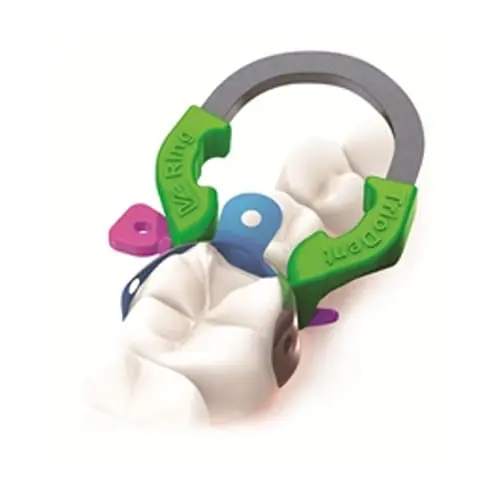
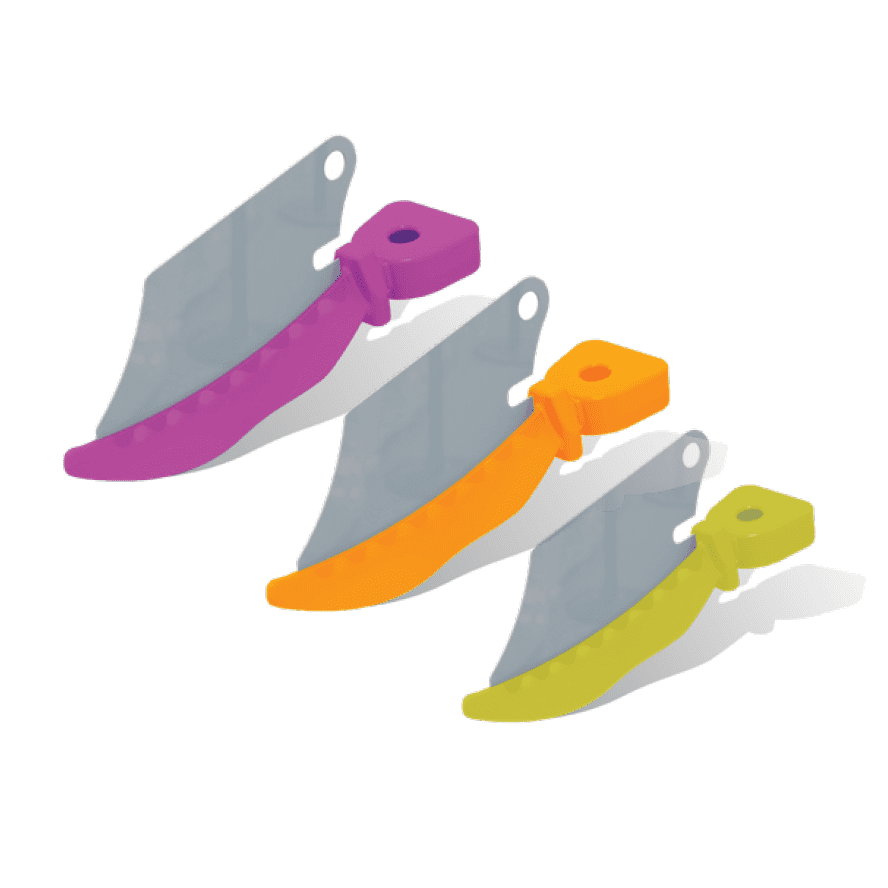
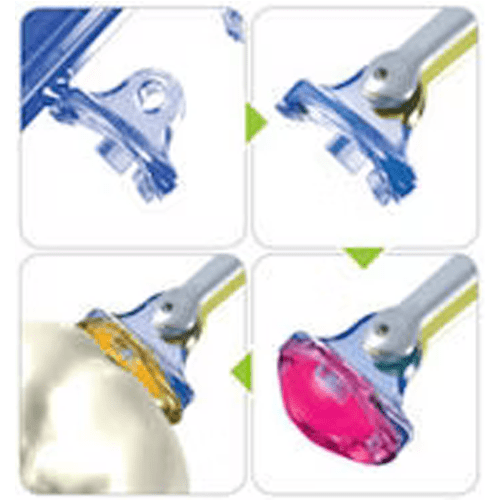
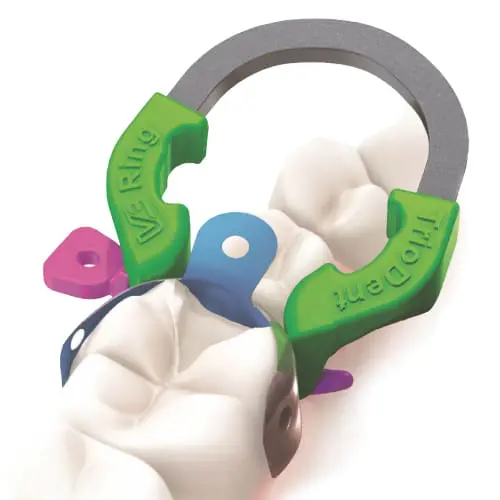
V-Ring is a sectional matrix system to facilitate the contouring of posterior restorations that involve interproximal surfaces. V-Ring separator ring has a stainless steel inside ring and a nickel-titanium outer spring with V-shaped tines. The tines are placed over the wedge on the buccal and lingual surfaces to enhance tooth separation. Each sectional matrix band has a tab with a hole on the occlusal edge and holes on the wing ends for locking pin tweezers to grasp during placement and removal. The matrices are available in three heights: 4.5, 5.5 and 6.5 mm. The system also includes V-Wedge and Double-Wedge. V-Wedge has an inverted V-shape cross-section and is available in six different colorcoded sizes. Double-Wedge is a clear, elastic wedge that is designed to be stretched and pulled between the teeth, rather than pushed like a traditional wedge. The kit evaluated contained three V-Rings, 50 Tab-Matrices in each of the three sizes, ring forceps, locking pin tweezers, and Double-Wedges. Fifteen consultants used the V-Ring system for 284 clinical restorations. This product received a 95% clinical rating.
Product Features
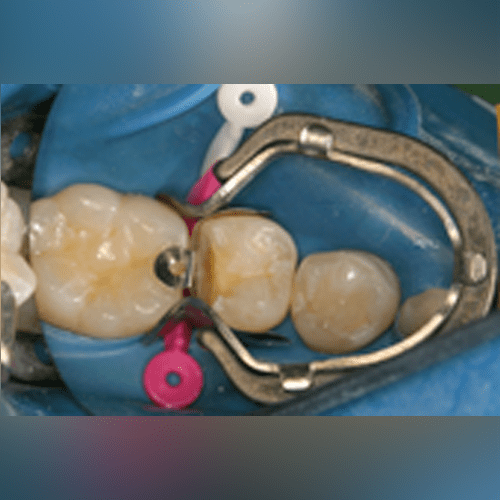
The limited written instructions are supported by a CD/DVD that clearly shows application of the V-Ring system in numerous clinical situations. More thorough written instructions would be useful when it is not convenient to view the CD/DVD. The plastic packaging is adequate but could be improved by having separate compartments for the various system components. The pin holes in the matrix bands aid in grasping the bands during placement and removal. Bands adapt well to the teeth, and the sizes provided are adequate for all clinical cases. The V-Wedges adapt well to the interproximal surfaces with a good selection of sizes. The fit of V-Ring to the buccal and lingual surfaces and the resultant separation of the teeth were rated excellent. Since the tines of the ring rest on the wedge rather than directly on the soft tissue, patient comfort is enhanced. The quality of the proximal contours and contacts was rated as very good. Overall, 92% of consultants rated the V-Ring system equivalent to or better than the sectional matrix system they were currently using, and they would both switch to and recommend it.
Clinical Tips
- The V-Ring should be expanded carefully to the required amount during placement. Do not open the rings excessively.
- The tab on the Tab-Matrix can be trapped against the neighboring tooth using a finger-tip and this prevents it from moving while placing the wedge.
- When it is necessary to wedge from both sides, the second wedge can be placed through the V-Ring’s V-shaped slot without having to start over.
Editors’ Note: The manufacturer is currently developing improved packaging and instructions. Look for the article in an upcoming issue of THE DENTAL ADVISOR.