

Consultants’ Comments
- “Easy to insert into interproximal spaces.”
- “Can be used with matrix and no retainer.”
- “Curved contour provides good fit and contacts – best cervical seal I have experienced.”
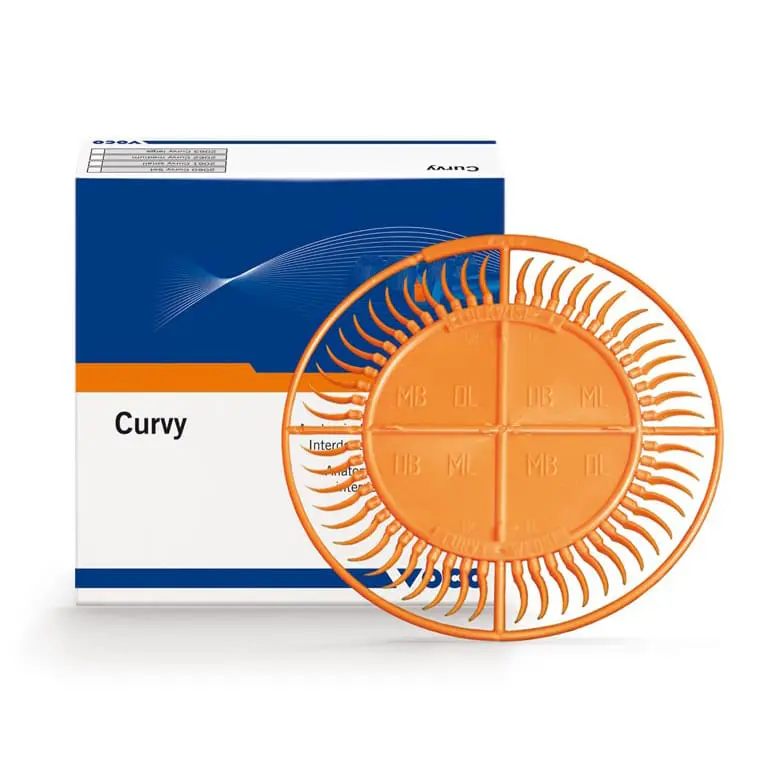
- “Poor labeling on circle – color coding is not intuitive.”
- “Design of wedge wheel is not optimal for infection control.”
- “Tips and edges of the wedges are sharp.”
Description
Curvy is a set of anatomically-shaped, plastic interdental wedges. The product is indicated for use as an aid for placing fillings, for applying pressure to matrices, and for temporarily separating teeth to shape the interproximal contact. The longitudinal curvature is designed to facilitate adaptation to the natural tooth geometry. The inverse “V” form is designed to correspond to the shape of the interproximal space and reduce the pressure of the wedge on the gingiva. When inserted into the interproximal space, the wedges follow the anatomy of the tooth to ensure a close adaptation of the matrix to the tooth and cavity. Curvy wedges come mounted on six 52-count discs and are arranged by color according to their clockwise (orange) or counter-clockwise (blue) curvature, and their sizes (light, medium and dark). Each disc is also divided into topographical range of use by quadrant. Curvy was evaluated by 30 consultants in 811 uses. It received an 84% clinical rating.
Product Features
Curvy is easy to insert into interproximal spaces. Consultants rated it highly for providing adaptation of the matrix band to the tooth and good contacts. The concave underside of the wedge protects the gingival papilla from trauma. The selection of the proper wedge is challenging because the labeling and color-coding are not well designed. Concerns about infection control were also noted. Thirty-three percent of consultants reported that Curvy was better than their current wedges and 17% reported that it was equivalent. Twenty-three percent would switch to Curvy and 40% would recommend it.
Clinical Tips
For restoration of adjacent Class II cavities, two wedges are required, one inserted from the buccal aspect and one from the lingual.
Refer to manufacturer’s instructions for information about the different colors and topographical allocation within the oral cavity.
Pull all wedges off the wheel and store separately for proper infection control.


