

Consultants’ Comments
- “The flow and dual-cured feature are great!”
- “Material is hard after setting, and it cuts very well.”
- “There is less waste and more control during placement.”
- “Good for block-out.”
- “Adapts well to pins/posts.”
Description
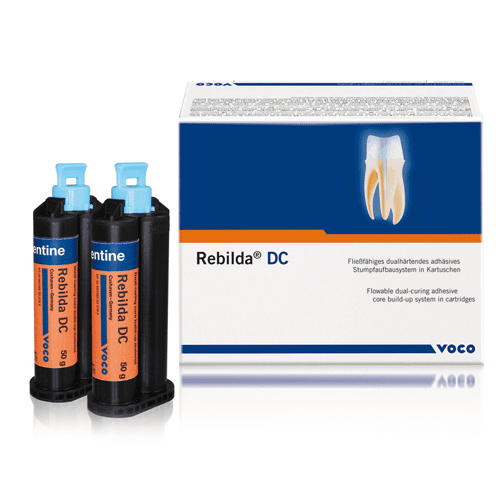
Rebilda DC is a dual-cured, radiopaque, flowable composite core build-up material. Three shades are available: blue, white, and dentin. It contains fluoride and is supplied in an auto-mixed system in either a 50-g cartridge or a 10-g QuickMix syringe. Mixing and intraoral tips are not interchangeable between the two systems. The kit with the 50-g cartridge contains a dispensing gun. The kits also include 4 ml each of Solobond Plus primer and adhesive plus accessories. The manufacturer recommends that Solobond Plus be used routinely with Rebilda DC. Twenty-three consultants used Rebilda DC in 302 clinical applications. This product received a 96% clinical rating.
Product Features
The optional packaging of Rebilda DC in the 10-g QuickMix syringe provides an economical inventory for stocking multiple operatories. The syringes also have small intraoral tips for easy application of the core material into deep preparations. Extrusion of the mixed material from both the syringe and the 50-g cartridge produces a minimal number of voids. Rebilda DC flows very well into undercuts and adapts well to posts and pins. The working time is 2 minutes with self-curing occurring at 5 minutes; however, the set can be initiated by light curing to speed the setting process. The usefulness of the dual-cured feature, hardness of the set material, ease of reduction, and the prepared surface were judged to be very good. Ninety-five percent of consultants rated Rebilda DC the same as or better than their current core material, while 86% would purchase it, and 91% would recommend it.
Clinical Tips
- For large cores, build incrementally by placing a small amount of material, curing for 5 seconds then adding layers as needed. This technique will prevent material from slumping.
Editors’ Note: The original evaluation was published in THE DENTAL ADVISOR, Vol. 21, No. 2, March 2004.


